
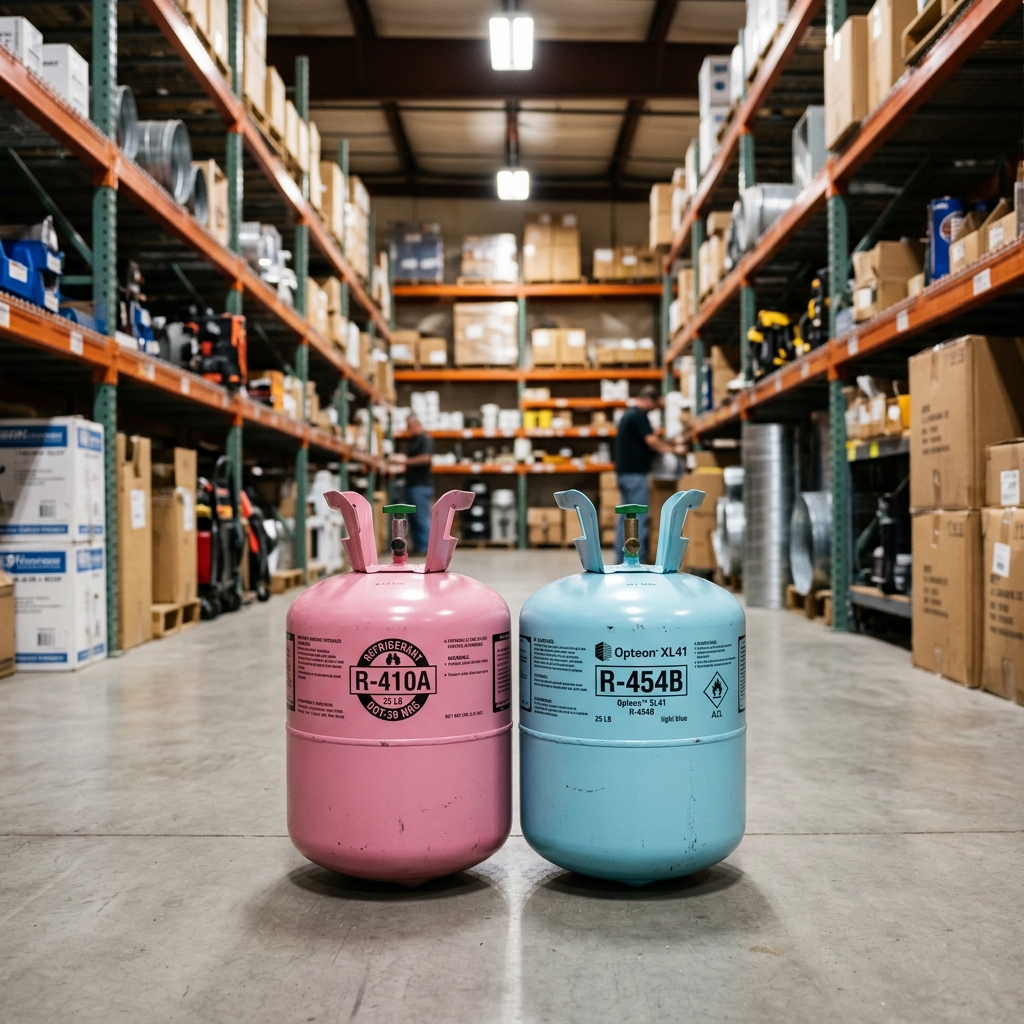
R-410A vs R-454B: What Technicians Need to Know
R-454B replaced R-410A in new equipment starting January 2025. GWP dropped 78%, from 2,088 to 466. Here's what changes for technicians and homeowners.
On January 1, 2025, the EPA's AIM Act phasedown took effect for residential and commercial air conditioning and heat pump equipment. All new systems manufactured after that date must use refrigerants with a global warming potential (GWP) of 700 or less (EPA, 2024). R-410A, with a GWP of 2,088, no longer qualifies. R-454B (marketed as Opteon XL41 by Chemours) has a GWP of 466 and has become the primary replacement for residential HVAC systems.
If you're an HVAC technician, this affects your daily work. If you're a homeowner, it affects what equipment you can buy and what happens when your current system needs service.
This guide covers the technical differences, safety implications, and what both groups need to know in 2026.
- R-454B replaced R-410A in new residential equipment starting January 2025 under the AIM Act.
- R-454B has a GWP of 466, which is 78% lower than R-410A's 2,088.
- R-454B is classified A2L (mildly flammable). R-410A is A1 (non-flammable).
- Existing R-410A systems are not affected. You can still service and recharge them.
- Technicians need updated training on A2L handling, leak detection, and charge limits.
What Is R-454B?
R-454B is a hydrofluoroolefin (HFO) blend made of 68.9% R-32 and 31.1% R-1234yf by weight. It was developed as a near drop-in replacement for R-410A in residential and light commercial systems.
Key properties:
| Property | R-410A | R-454B |
|---|---|---|
| GWP (AR5) | 2,088 | 466 |
| Safety class | A1 (non-flammable) | A2L (mildly flammable) |
| Boiling point | -51.4°C / -60.5°F | -50.9°C / -59.6°F |
| Critical temperature | 72.1°C / 161.8°F | 78.1°C / 172.6°F |
| Operating pressures | Similar | Slightly lower |
| Cooling capacity | Baseline | Within 5% of R-410A |
| COP (efficiency) | Baseline | 3 to 5% better |
Why Is R-410A Being Phased Out?
R-410A is a hydrofluorocarbon (HFC) with a high GWP. A GWP of 2,088 means one kilogram of R-410A released to the atmosphere has 2,088 times the warming effect of one kilogram of CO2 over a 100-year period.
The AIM Act (American Innovation and Manufacturing Act), signed in 2020, directs the EPA to phase down HFC production and consumption by 85% by 2036. The residential AC and heat pump sector was one of the first to transition because R-454B was already commercially ready (EPA, 2024).
This follows a global pattern. The Kigali Amendment to the Montreal Protocol commits nearly every country to phasing down HFCs on a similar timeline. The EU transitioned away from R-410A in many applications years before the US.
The A2L Classification: What "Mildly Flammable" Means
R-454B's A2L safety classification is the biggest practical difference from R-410A. Here's what that actually means.
ASHRAE 34 safety classifications:
A2L refrigerants have a burning velocity of less than 10 cm/s, which is very slow. For context, propane (A3) has a burning velocity of over 40 cm/s. R-454B will ignite under specific conditions (high concentration + ignition source), but it's very difficult to ignite in real-world residential settings. It doesn't "flash" like propane.
The practical impact for technicians:
For homeowners, the A2L classification has no practical impact on daily use. The equipment has built-in safety features (leak sensors, ventilation requirements, charge limits) that make it safe for residential installation.
What Changes for HVAC Technicians?
Training and Certification
Your EPA 608 certification still applies. The exam covers refrigerant handling for all types, including A2L refrigerants. However, manufacturers and industry organizations are offering specific A2L training:
If you're new to the trade and studying for your EPA 608 exam, the current study materials already include A2L content.
Installation Practices
The installation process for R-454B equipment is similar to R-410A with some additions:
Same as before:
New or updated requirements:
Service and Repair
For existing R-410A systems, nothing changes. You service them the same way you always have. R-410A will remain available for service for years.
For new R-454B systems:
Tools and Equipment
Most of your existing tools work with R-454B. A few updates:
What Changes for Homeowners?
Buying New Equipment
If you're buying a new AC or heat pump in 2026, it will use R-454B (or another approved low-GWP refrigerant like R-32). You can't buy new residential equipment with R-410A anymore.
The good news: performance is essentially the same. Your new R-454B system will cool and heat just as well as an R-410A system. Efficiency may be slightly better.
Equipment prices have absorbed the refrigerant transition cost. In 2025, R-454B equipment cost about 3 to 5% more than R-410A equipment at introduction. By mid-2026, prices have largely normalized as manufacturers scaled production. See our HVAC cost guide for current pricing.
Existing R-410A Systems
If you already have an R-410A system, you're fine. Nothing forces you to replace it. You can continue to maintain, repair, and recharge it for its full useful life.
R-410A will remain available for service for the foreseeable future. The AIM Act phases down production of new HFCs but doesn't ban servicing existing equipment. Reclaimed R-410A (recovered from decommissioned systems, cleaned, and resold) will also remain available.
That said, R-410A prices will gradually increase over time as supply tightens. If your R-410A system is 12+ years old and needs a major repair, the cost calculus may favor replacing it with a new R-454B system rather than investing in an aging unit with increasingly expensive refrigerant.
Can R-454B Replace R-410A in Existing Systems?
No. R-454B is not a drop-in replacement for R-410A in existing equipment. The two refrigerants have different operating characteristics, oil compatibility requirements, and safety classifications. You can't just swap the refrigerant. You need new equipment designed for R-454B.
Frequently Asked Questions
Is R-454B safe for homes?
Yes. Despite the A2L (mildly flammable) classification, R-454B is safe for residential use. The equipment has built-in safety features including leak sensors, ventilation requirements, and charge limits. The risk of ignition in a home is extremely low under normal conditions. All major manufacturers and the EPA have approved it for residential use.
Will R-410A be banned?
R-410A is not being banned from existing systems. The AIM Act prohibits manufacturing new residential equipment using R-410A starting January 2025, but existing systems can continue to use it. R-410A will remain available for servicing through reclamation and existing stock.
How much does R-454B cost compared to R-410A?
In mid-2026, R-454B costs roughly the same as R-410A per pound ($10 to $20 per pound at retail). As R-410A production declines, its price will likely increase over time while R-454B pricing stabilizes.
Do I need new tools for R-454B?
Most existing tools work. You may need to update your leak detector (infrared type recommended), verify your recovery machine is A2L rated, and use dedicated hoses to avoid cross-contamination between refrigerant types.
What other refrigerants are approved as R-410A replacements?
R-32 (GWP 675) is used by some manufacturers, particularly Daikin, mainly in ductless mini-splits. R-32 is also A2L and has slightly higher operating pressures than R-454B. Other approved options include R-466A and R-471A, but R-454B has the widest adoption in the US market for residential ducted systems.
Summary
The R-410A to R-454B transition is the biggest change in residential HVAC refrigerants since the R-22 to R-410A switch in 2010. Here's what you need to know:
The transition is here. For technicians, it means learning new procedures. For homeowners, it means your new system is better for the environment without any sacrifice in comfort. For a full breakdown of how this fits into the bigger picture of HVAC maintenance, keep your system well-maintained regardless of which refrigerant it uses.
About WorkerGear Team
HVAC Instructor and Certified EPA Technician. Dedicated to helping students and HVAC apprentices pass their trade certification exams on the first attempt with expert tips and exam insights.