
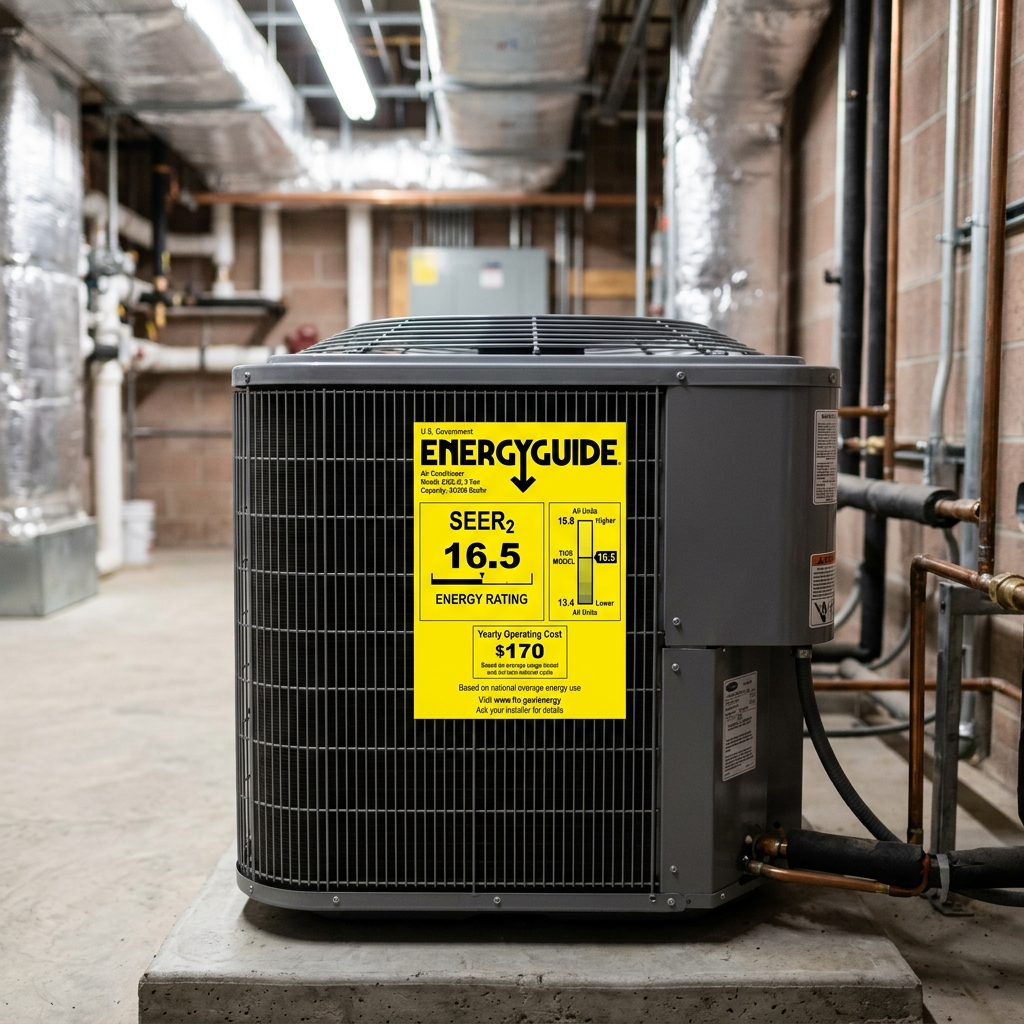
SEER2 Rating Explained: Energy Savings Guide
SEER2 replaced SEER in 2023 as the US efficiency standard. A 20 SEER2 unit uses 35% less electricity than a 13 SEER2. Learn what the numbers mean.
In January 2023, the US Department of Energy replaced SEER with SEER2 as the official standard for measuring air conditioning and heat pump efficiency (DOE, 2023). If you've been shopping for a new HVAC system, you've probably noticed the "2" at the end and wondered what changed.
The short answer: SEER2 uses a harder test. The new testing method (M1 blower setting) simulates real-world static pressure more accurately than the old method. That means SEER2 numbers run about 4.7% lower than the old SEER numbers for the same equipment. A unit that was rated 16 SEER under the old standard is now rated about 15.2 SEER2.
This guide explains what SEER2 actually measures, how it affects your energy bill, and what the current federal minimums are.
- SEER2 replaced SEER in January 2023. The new test is harder, so numbers are about 4.7% lower for the same equipment.
- Federal minimums in 2026 are 14.3 SEER2 in the North and 15 SEER2 in the South and Southwest.
- Going from 13 SEER2 to 20 SEER2 can save $300 to $500 per year on cooling costs.
- Higher SEER2 costs more upfront but pays back through lower monthly electricity bills.
- SEER2 only measures cooling efficiency. For heating, check HSPF2 (heat pumps) or AFUE (furnaces).
What Does SEER2 Stand For?
SEER2 stands for Seasonal Energy Efficiency Ratio 2. It measures how much cooling output (in BTU) a system produces per watt of electricity consumed over an entire cooling season.
The formula: SEER2 = total cooling output (BTU) / total electrical input (Wh) over a season.
A higher number means the system uses less electricity to produce the same amount of cooling. A 20 SEER2 unit uses roughly 35% less electricity than a 13 SEER2 unit to cool the same space.
The "seasonal" part matters. SEER2 is an average across a range of outdoor temperatures (65°F to 104°F), not a single-point measurement. Your system doesn't run at its SEER2 rating at all times. On a 75°F day, it's more efficient than its rating. On a 100°F day, it's less efficient. SEER2 is the average across a typical cooling season.
SEER vs SEER2: What Changed?
The equipment didn't change. The test did.
Under the old SEER standard, systems were tested with an external static pressure of 0.1 inches of water column (in. w.c.). That represented ideal conditions with no ductwork resistance. Real ductwork creates more resistance than that.
SEER2 uses the M1 blower setting with an external static pressure of 0.5 in. w.c., which is closer to what a typical residential duct system actually produces. Since the system has to work harder against that resistance, the measured efficiency is slightly lower.
The conversion is straightforward: SEER2 ≈ SEER × 0.953 (roughly a 4.7% reduction).
| Old SEER Rating | Approximate SEER2 Equivalent |
|---|---|
| 13 SEER | 12.4 SEER2 |
| 14 SEER | 13.4 SEER2 |
| 16 SEER | 15.2 SEER2 |
| 18 SEER | 17.2 SEER2 |
| 20 SEER | 19.1 SEER2 |
| 25 SEER | 23.8 SEER2 |
What Are the 2026 Federal Minimums?
The DOE sets minimum efficiency standards that vary by region and equipment type. As of 2026:
Split-system air conditioners:
Split-system heat pumps:
Packaged systems:
The North/South line roughly follows the Mason-Dixon line. States like Virginia, Kentucky, and Oklahoma fall in the South region. The DOE publishes the exact map on Energy.gov.
Contractors can't legally install equipment below these minimums. If someone offers you a 12 SEER2 system in 2026, something is wrong.
How SEER2 Affects Your Energy Bill
The relationship between SEER2 and electricity cost is direct. Here's how to estimate annual cooling costs:
Formula: Annual cooling cost = (BTU capacity × cooling hours) / (SEER2 × 1,000) × electricity rate
For a typical 3-ton (36,000 BTU) system running 2,000 hours per year at $0.167/kWh (the 2025 US average per the EIA):
| SEER2 Rating | Annual Cooling Cost | Savings vs. 13 SEER2 |
|---|---|---|
| 13 | $923 | Baseline |
| 15 | $800 | $123/year |
| 18 | $667 | $256/year |
| 20 | $600 | $323/year |
| 25 | $480 | $443/year |
Is a Higher SEER2 Worth the Extra Cost?
The upfront price difference between efficiency tiers is real. A 20 SEER2 system costs $1,500 to $3,000 more than a 14 SEER2 system of the same capacity.
Whether that pays back depends on how much you use your AC.
High-SEER2 pays back quickly if:
High-SEER2 pays back slowly if:
In a hot southern climate, upgrading from 15 to 20 SEER2 saves roughly $200 per year. That $1,500 to $2,500 upfront premium pays for itself in 8 to 12 years. In a cooler climate, it might take 15+ years.
A good middle ground for most homeowners: buy 2 to 3 SEER2 tiers above the federal minimum. You get meaningful savings without the steep premium of top-tier equipment.
What About Other Efficiency Ratings?
SEER2 only tells you about cooling efficiency. HVAC systems have other efficiency metrics:
EER2 (Energy Efficiency Ratio 2): Measures cooling efficiency at a single outdoor temperature (95°F). While SEER2 is a seasonal average, EER2 tells you how the system performs on the hottest day. Useful in climates where every day is hot.
HSPF2 (Heating Seasonal Performance Factor 2): Measures heat pump heating efficiency across a heating season. Higher is better. The federal minimum is 7.5 HSPF2. A good cold-climate heat pump has an HSPF2 of 10 to 12. This metric only applies to heat pumps, not furnaces.
AFUE (Annual Fuel Utilization Efficiency): Measures furnace efficiency as a percentage. An 80% AFUE furnace converts 80 cents of every fuel dollar into heat. A 96% AFUE condensing furnace converts 96 cents. This metric only applies to gas and oil furnaces, not heat pumps.
COP (Coefficient of Performance): Used more in engineering than consumer shopping. A COP of 3.0 means the system produces 3 units of heat for every 1 unit of electricity. Heat pumps typically have a COP of 2 to 4 depending on outdoor temperature.
How Variable-Speed Systems Change the Equation
Traditional single-speed HVAC systems run at 100% capacity or not at all. They cycle on, blast cold air, hit the thermostat setpoint, and cycle off. This constant starting and stopping wastes energy.
Variable-speed (inverter-driven) systems adjust their output continuously. On a mild day, the compressor might run at 30% capacity instead of cycling between 0% and 100%. This uses significantly less electricity and maintains more even temperatures.
Variable-speed systems tend to have the highest SEER2 ratings (18 to 30+). Ductless mini-splits almost always use inverter compressors, which is why their efficiency ratings are so high.
If you're comparing two systems with similar SEER2 ratings, check whether the compressor is single-speed, two-stage, or variable-speed. The variable-speed unit will likely perform closer to its rated SEER2 in real-world conditions.
Frequently Asked Questions
Is SEER2 the same as SEER?
No. SEER2 uses a harder test that simulates real ductwork resistance. SEER2 numbers are about 4.7% lower than SEER numbers for the same equipment. A 16 SEER system would be rated approximately 15.2 SEER2 under the new standard.
What is a good SEER2 rating?
For central AC in 2026, anything above 16 SEER2 is good. Above 20 SEER2 is very efficient. The federal minimum is 14.3 to 15 SEER2 depending on your region. For ductless mini-splits, ratings above 20 SEER2 are standard, with some models exceeding 30 SEER2.
Does SEER2 apply to heating?
No. SEER2 only measures cooling efficiency. For heat pump heating efficiency, look at HSPF2. For gas furnace efficiency, look at AFUE. These are separate ratings that measure different things.
Will a higher SEER2 system save me money?
Yes, on monthly electricity bills. The savings depend on how much you use your AC, your local electricity rate, and how big the SEER2 jump is. Going from 13 to 20 SEER2 in a hot climate can save $300 to $500 per year. In a mild climate, the savings are smaller.
Do I have to buy a SEER2-rated system?
All new residential AC and heat pump equipment manufactured after January 2023 is rated under the SEER2 standard. You can't buy new equipment rated only in SEER anymore. Existing systems keep their original SEER rating for reference, but any replacement will come with a SEER2 label.
Summary
SEER2 is the current standard for measuring how efficiently your air conditioner or heat pump cools your home. Higher SEER2 means lower electricity bills.
When shopping, buy 2 to 3 tiers above the minimum for the best balance of upfront cost and long-term savings. And always ask your contractor what the total system cost looks like, not just the equipment price.
About WorkerGear Team
HVAC Instructor and Certified EPA Technician. Dedicated to helping students and HVAC apprentices pass their trade certification exams on the first attempt with expert tips and exam insights.