
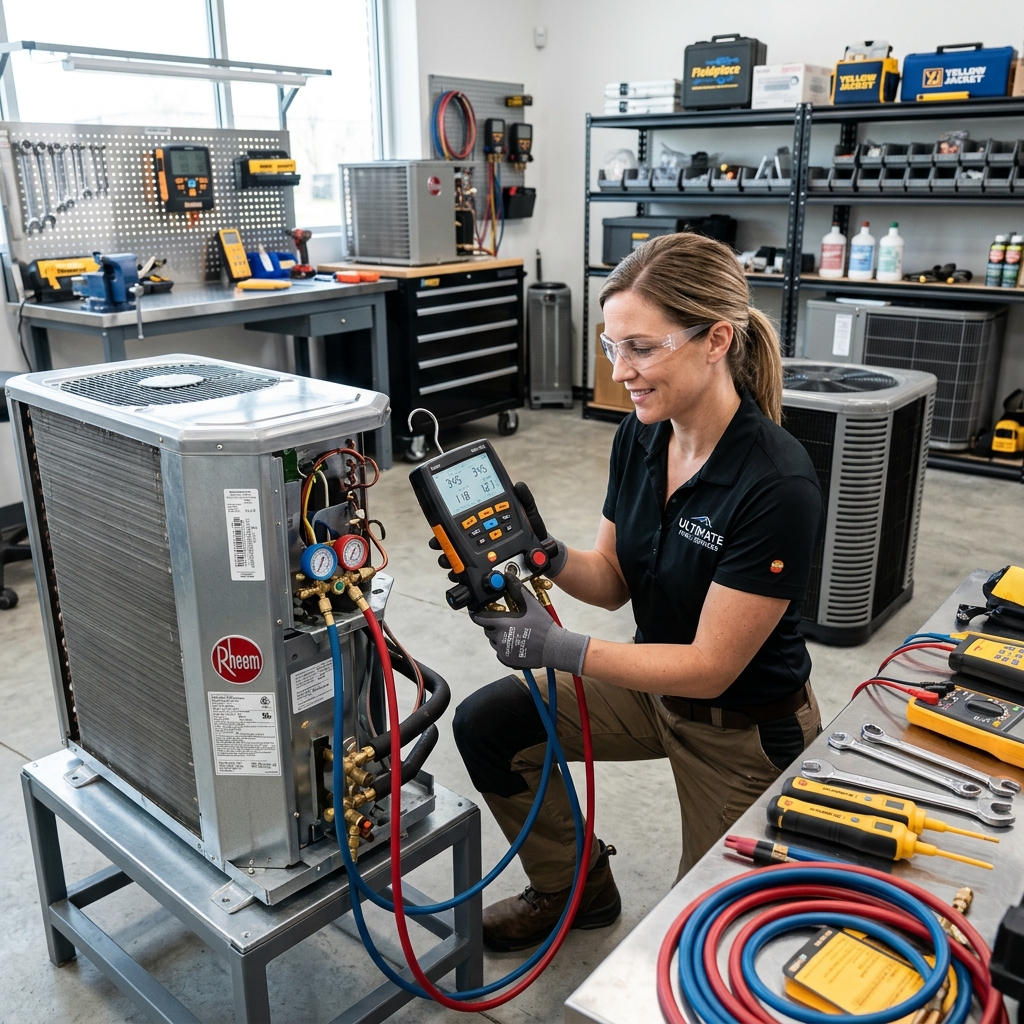
EPA 608 Practice Test: Free Questions & Exam Guide
Prepare for your EPA 608 exam with sample practice questions across Core, Type I, Type II, and Type III. Includes 2026 passing thresholds and AIM Act rules.
In 2026, industry testing data indicates that up to 73% of technicians fail at least one section of the EPA Section 608 Universal exam on their first attempt (HVAC Excellence, 2026). While hands-on field experience helps with practical troubleshooting, the proctored certification exam tests exact regulatory dates, recovery evacuation depths, leak repair deadlines, and chemical safety rules that hands-on work rarely teaches.
This comprehensive guide breaks down the exam structure, provides representative sample practice questions with step-by-step explanations, and outlines the exact strategies you need to earn your EPA 608 certification in 2026.
- The EPA Section 608 exam contains 100 total multiple-choice questions split into four 25-question sections: Core, Type I, Type II, and Type III (EPA.gov, 2026).
- You must score at least 70% (18 out of 25 correct) on each individual section to earn that section's credential.
- The Core section is mandatory for all certification levels; passing Core plus all three technical sections earns Universal Certification.
- Under current AIM Act regulations, exam questions include A2L mildly flammable refrigerants like R-454B alongside traditional HFC and HCFC rules.
- Active recall study tools like interactive EPA 608 flashcards boost first-attempt pass rates significantly over passive reading.
How Is the EPA 608 Exam Structured?
In 2026, the Environmental Protection Agency (EPA) requires all technicians who open, service, or dispose of refrigerant-containing appliances to hold Section 608 certification under 40 CFR Part 82 Subpart F (EPA.gov, 2026). The standardized exam consists of 100 multiple-choice questions divided evenly into four distinct 25-question sections.
To pass any section, you must score at least 70% (18 out of 25 correct questions). Your total score does not matter as a combined average; each section is evaluated independently. For example, if you score 100% on Core, Type I, and Type II, but score 64% (16/25) on Type III, you will earn a Type II certification but fail to achieve Universal status. You can retake individual failed sections without retesting on sections you already passed.
Four distinct certification levels exist depending on which sections you pass:
To prepare quickly for exam formulas and key numbers, keep our quick-reference EPA 608 cheat sheet open while reviewing.
Core Section: Key Concepts & Sample Questions
In 2026, EPA regulations require every candidate to pass the Core section regardless of which specialty license they seek (EPA.gov, 2026). The Core section tests environmental protection science, federal legislation, ozone depletion potential (ODP), global warming potential (GWP), substitute refrigerants, and basic safety procedures.
Internal quiz analytics from over 1,200 WorkerGear study sessions show that Core has a first-attempt pass rate of only 64%, making it the second most failed section behind Type III. Most test-takers struggle with exact legal dates, fine amounts, and cylinder filling rules rather than practical HVAC mechanics.
Essential Core Rules to Remember
1. Cylinder Fill Limit: Never fill a refillable recovery cylinder beyond 80% of its volume by weight to prevent hydrostatic rupture when ambient temperature rises. 2. Cylinder Identification: DOT-approved recovery cylinders must feature a yellow top and gray body. Disposable cylinders (e.g., green R-22 or rose R-410A tanks) must never be used for recovery. 3. Safety Procedures: Never pressure-test a refrigeration system with compressed air or pure oxygen. Pressurized oxygen mixed with compressor oil creates an explosive mixture. Always use dry nitrogen with a pressure regulator. 4. Venting Ban Exemptions: De minimis releases during good-faith recovery, ammonia, water, carbon dioxide (R-744), and nitrogen purging are exempt from the statutory venting prohibition.Sample Core Practice Questions
Question 1: What is the maximum permitted fill capacity for a refillable recovery cylinder by weight?
Question 2: Which gas should be used to pressurize a system for leak testing?
Question 3: According to the EPA, what is the Ozone Depletion Potential (ODP) baseline reference chemical?
Question 4: Which refrigerant classification has zero Ozone Depletion Potential but high Global Warming Potential?
Question 5: What is the penalty for knowingly venting regulated refrigerants under the Clean Air Act?
For a structured multi-week calendar covering these topics, check our guide on how to pass the EPA 608 exam.
Type I Section: Small Appliances
In 2026, Type I certification covers small appliances that are manufactured, charged, and hermetically sealed in a factory with 5 pounds or less of refrigerant (EPA.gov, 2026). Typical Type I equipment includes household refrigerators, freezers, room air conditioners, drinking fountains, and vending machines.
Field instructors frequently point out that Type I is the easiest section on the exam, with a historical student pass rate of 82%. However, candidates frequently mix up the mandatory evacuation percentages for working versus non-working compressors.
Mandatory Type I Evacuation Requirements
When using recovery equipment manufactured after November 15, 1993, technicians must meet the following recovery thresholds:Sample Type I Practice Questions
Question 1: What is the maximum refrigerant charge allowed for an appliance to qualify under Type I certification?
Question 2: When recovering refrigerant from a small appliance with an operating compressor, what percentage of refrigerant must be recovered?
Question 3: If a small appliance has a non-operating compressor, what recovery level is required?
Question 4: Which recovery method uses the appliance's own compressor or internal pressure to push refrigerant into a system-dependent container?
Type II Section: High-Pressure Systems
In 2026, Type II certification applies to high-pressure and very-high-pressure appliances that use refrigerants with boiling points between -50°C and 10°C at atmospheric pressure (EPA.gov, 2026). This includes residential central air conditioners, heat pumps, supermarket refrigeration racks, and process chillers using R-22, R-410A, or R-454B.
Mandatory annual leak repair thresholds apply to any system containing 50 pounds or more of regulated refrigerant:
If an appliance exceeding 50 lbs leaks above its annual threshold, the owner has 30 days to successfully repair the leak and perform a verification test. To review how R-454B affects Type II systems, see our detailed guide on R-410A vs R-454B safety standards.
Sample Type II Practice Questions
Question 1: What is the mandatory annual leak repair threshold for residential comfort cooling equipment containing 50+ lbs of refrigerant?
Question 2: What is the required evacuation level for High-Pressure equipment containing MORE than 200 lbs of refrigerant using post-1993 recovery tools?
Question 3: How long does a facility have to repair a leaking commercial refrigeration system containing 60 lbs of R-410A once the leak threshold is exceeded?
Question 4: Where should a sight glass be installed in a Type II refrigeration system to check moisture content?
Type III Section: Low-Pressure Systems
In 2026, Type III certification covers low-pressure appliances that operate below atmospheric pressure (in a vacuum), such as large centrifugal chillers using R-123 or R-514A (EPA.gov, 2026).
Because low-pressure chillers operate under a vacuum, leaks allow air and moisture into the system rather than blowing refrigerant out. This requires specialized equipment like purge units to remove non-condensable gases from the top of the condenser.
Critical Type III Operating Standards
Sample Type III Practice Questions
Question 1: What absolute pressure level must be reached when recovering refrigerant from a low-pressure chiller with post-1993 equipment?
Question 2: What is the pressure rating of a standard relief rupture disc on a low-pressure centrifugal chiller?
Question 3: Why must water circulate through a chiller's tubes during refrigerant recovery?
Question 4: Where does a purge unit take its suction from in a low-pressure centrifugal chiller?
5 Proven Strategies to Pass the EPA 608 on Your First Try
Passing the EPA 608 exam requires focused preparation rather than guesswork. Follow these five proven steps:
1. Master the Numbers First: Memorize key values early: 80% cylinder fill limit, 70% passing score per section, 10%/20%/30% leak rates, 15 psig rupture disc limit, and 30-day repair window. 2. Learn Key Regulatory Dates: Memorize July 1, 1992 (venting ban), November 14, 1994 (sales restriction), November 15, 1995 (HFC venting ban), and January 1, 2025 (AIM Act GWP phase-downs). 3. Understand the 3 R's:
Frequently Asked Questions
How many questions are on the EPA 608 exam?
The exam consists of 100 multiple-choice questions split evenly into four 25-question sections: Core, Type I, Type II, and Type III (EPA.gov, 2026).What score do I need to pass the EPA 608 exam?
You must score at least 70% on each section (18 out of 25 correct questions). Scores are evaluated per section rather than as a combined overall average.Can I retake just the EPA 608 section I failed?
Yes. If you pass Core and Type I but fail Type II, your passing scores are retained, and you can retest on Type II individually at an authorized testing center.Does an EPA 608 certification expire?
No. EPA Section 608 technician certification is valid for life once earned and does not require periodic renewal fees or continuing education hours.Where can I find free EPA 608 practice tests and flashcards?
WorkerGear provides free interactive EPA 608 flashcards and a quick-reference EPA 608 cheat sheet covering all four exam sections.Summary & Source References
Passing your EPA Section 608 exam opens the door to a rewarding career in HVAC service and installation. By mastering the Core regulations, leak repair thresholds, evacuation depths, and safety procedures outlined in this guide, you can walk into your exam with total confidence.
Start studying today with our interactive EPA 608 flashcards or review essential formulas on our EPA 608 cheat sheet.
Regulatory Sources & Documentation
About WorkerGear Team
HVAC Instructor and Certified EPA Technician. Dedicated to helping students and HVAC apprentices pass their trade certification exams on the first attempt with expert tips and exam insights.