
What Is HVAC? How Heating & Cooling Works
HVAC stands for Heating, Ventilation, and Air Conditioning. Learn how home systems work, key components, average costs, and simple maintenance.
HVAC systems use roughly 40% of total energy in commercial buildings, according to a 2024 report by the International Energy Agency. That makes them the single largest energy expense in most structures. Yet most people can't explain how their system actually works until something breaks down in the middle of August.
This guide covers what HVAC means, how each component functions, what system types exist, and what you need to know before buying or maintaining one. Whether you're a homeowner comparing quotes or someone entering the HVAC trade, this is where you start.
- HVAC stands for Heating, Ventilation, and Air Conditioning. It is not the same as "AC."
- These systems account for about 40% of commercial building energy use (IEA, 2024).
- The four main system types are split systems, packaged units, ductless mini-splits, and heat pumps.
- As of January 2025, new US residential equipment must use R-454B refrigerant under the AIM Act.
- A typical residential system lasts 15 to 20 years with regular maintenance.
What Does HVAC Stand For?
HVAC stands for Heating, Ventilation, and Air Conditioning. The term covers every system that controls temperature, humidity, and air quality inside a building. In 2026, the global HVAC market is valued at $297 to $333 billion, depending on which report you reference (Research and Markets, 2026).
Heating is the part that keeps you warm. Furnaces burn gas or oil to produce heat. Heat pumps move heat from outdoor air into your home (yes, even cold air has extractable heat). Boilers heat water and circulate it through radiators or radiant floor systems.
Ventilation is the exchange of indoor air with outdoor air. It removes stale air, moisture, smoke, and pollutants. It also brings in fresh oxygen. Mechanical ventilation uses fans and ductwork. Natural ventilation uses windows and vents. Most modern buildings rely on mechanical ventilation because you can filter and condition the air before it enters your living space.
Air Conditioning removes heat from indoor air and releases it outside. It uses a refrigeration cycle. We'll cover how that works in the next section.
One common confusion: HVAC and AC aren't the same thing. AC is one component of the full HVAC system. When a contractor says "your HVAC," they're talking about the entire heating, ventilation, and cooling setup, not just the air conditioner.
How Does an HVAC System Work?
All HVAC systems work by moving heat from one place to another. In 2025, global electricity demand for space cooling reached approximately 2,900 terawatt-hours, a 50% increase since 2015 (IEA, 2025). That number keeps climbing because more people are buying air conditioning every year.
The cooling side runs on the refrigeration cycle. Here's what happens:
1. The evaporator coil (indoor) absorbs heat from your home's air. Warm air blows across the cold coil, and the refrigerant inside absorbs that heat. 2. The compressor (outdoor) pressurizes the refrigerant, raising its temperature even higher. 3. The condenser coil (outdoor) releases that heat into the outside air. 4. The expansion valve drops the refrigerant's pressure and temperature, sending it back to the evaporator to start the cycle again.
The heating side works differently depending on your equipment. A gas furnace burns fuel and pushes heated air through ductwork. A heat pump reverses the refrigeration cycle, pulling heat from outdoor air and pushing it inside. Heat pumps don't generate heat. They transfer it.
The thermostat ties everything together. It reads the indoor temperature, compares it to your setpoint, and signals the system to heat or cool until the room matches what you asked for.
What Are the Main Components of an HVAC System?
A typical residential HVAC system has six or seven core parts. Each one has a specific job, and if any single component fails, the whole system underperforms.
Furnace or heat source. Usually gas-fired, installed in a basement, attic, or utility closet. It burns fuel, generates heat, and passes it through a heat exchanger. In warmer climates, a heat pump handles both heating and cooling, replacing the furnace entirely.
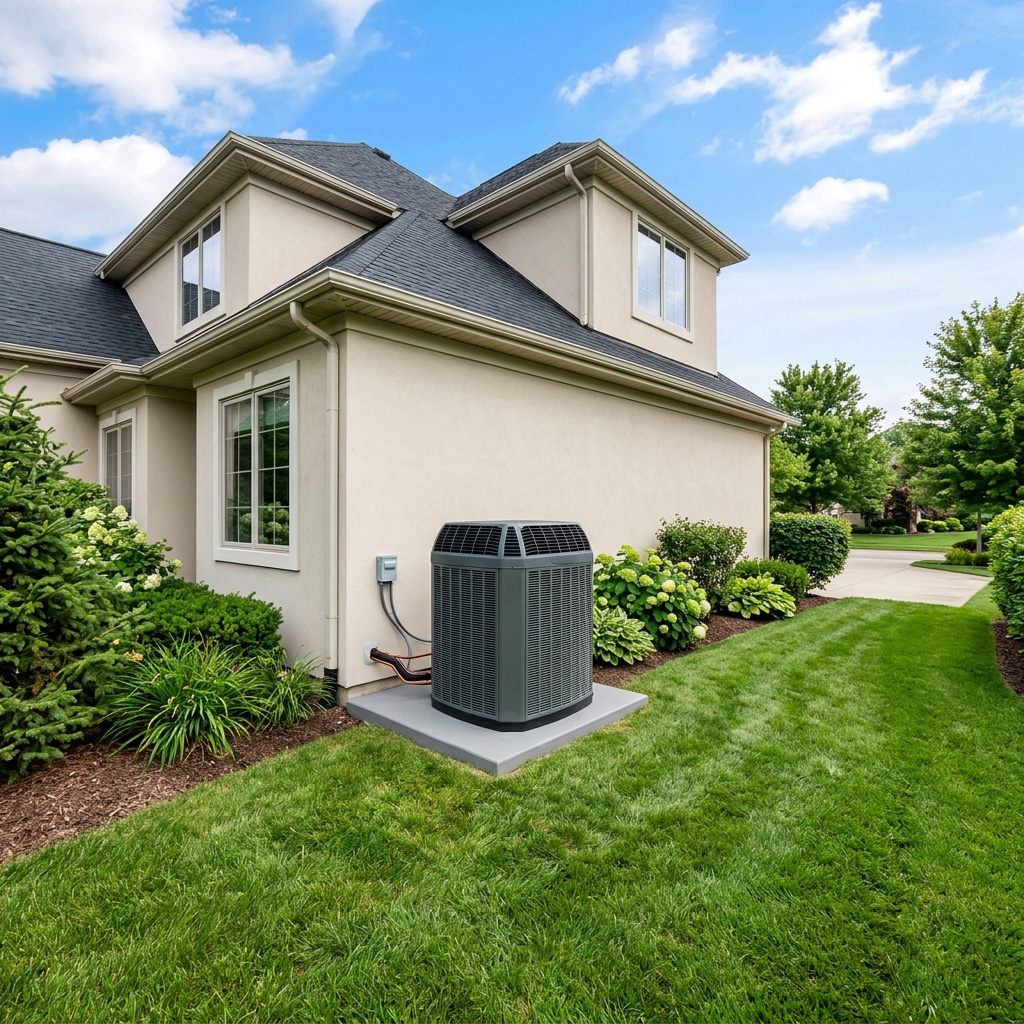
Outdoor unit (condenser/compressor). This is the box sitting outside your house. It contains the compressor, condenser coil, and a fan. The compressor is the most expensive single component to replace.
Evaporator coil. Sits inside the air handler or on top of the furnace. Refrigerant flows through it, absorbing heat from indoor air. If this coil freezes, your AC stops cooling. That usually means low refrigerant or restricted airflow.
Air handler and blower motor. The blower pushes conditioned air through ductwork and into your rooms. Variable-speed blowers are quieter and more efficient than single-speed models.
Ductwork. The network of metal or flexible tubes that distribute air. Leaky ducts can waste 20 to 30% of the air your system produces. You won't feel that wasted air, but you'll see it on your energy bill.
Thermostat. The control unit. Programmable and smart thermostats let you set schedules and adjust remotely. A properly configured thermostat can cut heating and cooling costs by 10% or more.
Air filter. Catches dust, pollen, and debris before they reach the evaporator coil. A clogged filter restricts airflow, forces the system to work harder, and increases energy consumption.
What Are the Different Types of HVAC Systems?
There are four main types of residential HVAC systems. In 2026, the U.S. HVAC market alone is estimated at roughly $165 billion (BDR, 2026), and the majority of that spending goes toward split systems and heat pumps.
Split systems are the most common type in the US. An outdoor unit (condenser) pairs with an indoor unit (furnace + evaporator coil). They connect through refrigerant lines. Most American homes built after 1970 use this setup.
Packaged systems put everything in a single outdoor cabinet. Heating, cooling, and the blower all live in one box, usually installed on a roof or concrete slab. Common in commercial buildings and smaller homes without basement space.
Ductless mini-splits skip the ductwork. An outdoor compressor connects to one or more indoor wall-mounted units. Each indoor unit controls its own zone. Good for additions, older homes without ducts, or rooms where running ductwork is impractical.
Heat pumps handle both heating and cooling with one system. They move heat instead of generating it, which makes them more energy-efficient than furnaces in moderate climates. In very cold regions, a dual-fuel setup pairs a heat pump with a gas furnace as backup.
| System Type | Best For | Typical Cost (Installed) | SEER2 Range | Average Lifespan |
|---|---|---|---|---|
| Split System | Most US homes with existing ductwork | $5,000 to $9,000 | 14 to 22 | 15 to 20 years |
| Packaged System | Homes without basements, commercial buildings | $4,500 to $8,500 | 13 to 16 | 12 to 15 years |
| Ductless Mini-Split | Older homes, room additions, zone control | $3,000 to $7,000 | 15 to 30+ | 15 to 20 years |
| Heat Pump | Moderate climates, efficiency-focused homeowners | $4,500 to $10,000 | 14 to 23 | 15 to 20 years |
From the field: The single most common mistake homeowners make is oversizing their system. A bigger unit doesn't mean better cooling. An oversized AC short-cycles, meaning it turns on, cools the air too fast, shuts off, then restarts minutes later. That constant cycling wastes energy, wears out the compressor faster, and leaves your home humid because the system never runs long enough to pull moisture from the air. Always insist on a Manual J load calculation before anyone quotes you a tonnage.
How Do HVAC Efficiency Ratings Work?
In January 2023, the US Department of Energy replaced SEER with SEER2 as the standard for measuring cooling efficiency (DOE, 2023). The new testing method uses the M1 blower setting, which simulates real-world static pressure more accurately than the old test.
Here's what each rating measures:
SEER2 (Seasonal Energy Efficiency Ratio 2) rates cooling efficiency. Higher is better. A 16 SEER2 unit uses roughly 20% less electricity than a 13 SEER2 unit over a cooling season. Federal minimums vary by region: 14.3 SEER2 in the North, 15 SEER2 in the South and Southwest.
HSPF2 (Heating Seasonal Performance Factor 2) rates heat pump heating efficiency. The federal minimum is 7.5 HSPF2.
AFUE (Annual Fuel Utilization Efficiency) rates furnace efficiency as a percentage. An 80% AFUE furnace converts 80 cents of every fuel dollar into heat. The other 20 cents goes up the flue. High-efficiency condensing furnaces hit 95 to 98% AFUE.
What do these numbers mean for your wallet? Going from 13 SEER2 to 20 SEER2 on a system that runs 2,000 hours per year can save $300 to $500 annually on cooling costs. The exact savings depend on your local electricity rate and how much you run the system.
What Is the R-410A to R-454B Refrigerant Transition?
Starting January 1, 2025, all new residential air conditioning and heat pump equipment manufactured in the United States must use refrigerants with lower global warming potential (GWP) under the AIM Act. R-454B (marketed as Opteon XL41) has a GWP of 466, which is 78% lower than R-410A's GWP of 2,088 (EPA, 2025).
What does this mean if you're a homeowner? If you already have an R-410A system, it isn't going away. Technicians can still service it. R-410A will be available for maintenance and repair for years. But if you're buying a new system in 2025 or later, it will use R-454B or another approved low-GWP alternative.
What does this mean if you're entering the trade? R-454B is classified as A2L, meaning it's mildly flammable. That changes installation and handling procedures. You need to follow updated safety codes, use proper leak detection equipment, and understand the new pressure-temperature charts. And you absolutely need your EPA 608 certification before touching any refrigerant.
The R-410A phase-down was a long time coming. R-410A replaced R-22 (Freon) starting in 2010, and now R-454B is replacing R-410A. Each generation has a significantly lower impact on the atmosphere. For HVAC technicians, this cycle of refrigerant transitions is part of the job. Staying current on regulations is as important as knowing how to braze copper.
How Much Does an HVAC System Cost?
A full residential HVAC system replacement typically costs $5,000 to $12,000 installed, with most homeowners paying $7,500 to $8,500 in 2025 and 2026. The price depends heavily on what you're buying and where you live.
Here's the general cost breakdown:
Several factors push the price up or down. Larger homes need larger systems. If your existing ductwork is leaky or undersized, that's an additional cost. Higher SEER2 ratings cost more upfront but save money long-term on energy bills. Geographic region matters too: labor rates in New York City are different from labor rates in rural Texas.
One thing worth knowing: the Inflation Reduction Act (IRA) provides up to $2,000 in federal tax credits for qualifying heat pump installations through 2032 (IRS/Energy.gov, 2024). Many states and utilities stack additional rebates on top of that. Always check DSIRE for your area's current incentives before signing a contract.
Don't just accept the first quote you get. Get three written estimates from different contractors. Compare the scope of work, not just the bottom line number.
What Should You Know About HVAC Maintenance?
In 2024, the U.S. Department of Energy reported that regular HVAC maintenance can reduce energy bills by 15 to 25% (DOE, 2024). It also extends the useful life of your system by 5 to 10 years.
Here's what regular maintenance looks like:
Change your air filter every 1 to 3 months. This is the single easiest thing you can do. A dirty filter restricts airflow, makes your system work harder, and can freeze the evaporator coil. If you have pets, change it monthly.
Schedule professional tune-ups twice a year. Once in spring before cooling season. Once in fall before heating season. A technician will check refrigerant levels, clean coils, inspect electrical connections, test the thermostat, and lubricate moving parts.
Watch for warning signs. Strange noises (grinding, squealing, banging), uneven temperatures between rooms, rising energy bills with no change in usage, or the system cycling on and off rapidly. Any of these signals a problem that gets worse and more expensive if you ignore it.
What you can do yourself: Change filters, keep the outdoor unit clear of debris and vegetation (maintain 2 feet of clearance), make sure all vents and registers are open and unblocked, and check your thermostat batteries.
What needs a professional: Refrigerant recharging, electrical work, cleaning evaporator and condenser coils, ductwork inspection and sealing, and anything that involves opening the sealed refrigerant system.
HVAC Careers and Certification
In 2024, the Bureau of Labor Statistics reported a median annual salary of approximately $53,000 for HVAC mechanics and installers in the United States. The BLS also projects 6% job growth for this occupation through 2032, which is faster than average across all jobs (BLS, 2024).
If you're considering a career in HVAC, here's what you need to know.
EPA 608 certification is required by federal law for anyone who handles refrigerants. The exam has four sections: Core (regulations), Type I (small appliances), Type II (high-pressure systems), and Type III (low-pressure systems). Passing all four earns you Universal certification. Most employers want Universal. You can study for it using our EPA 608 flashcards and cheat sheet, or read the full breakdown in our EPA 608 exam guide.
There are two main paths into the trade. Trade school programs typically run 6 to 24 months and give you classroom instruction plus lab time. Apprenticeships take 3 to 5 years and pay you while you learn on the job under a licensed journeyman.
The work is physical. You'll be on rooftops, in crawl spaces, and in attics. You'll work in extreme heat and cold. But the pay is solid, the job can't be outsourced, and there's constant demand. People will always need heating and cooling.
Frequently Asked Questions
What is the difference between HVAC and AC?
AC stands for air conditioning, and it only handles cooling. HVAC includes heating, ventilation, and air conditioning. It's the complete system. When someone says "your HVAC," they mean the furnace, AC, ductwork, thermostat, and air filtration working together. Most residential buildings use a full HVAC system even if people casually call it "the AC."
How long does an HVAC system last?
Most residential HVAC systems last 15 to 20 years with proper maintenance. Furnaces tend to last longer (20 to 30 years), while air conditioners and heat pumps average 15 to 20 years (ASHRAE, 2023). The two biggest factors that shorten lifespan are skipping maintenance and running an oversized system that short-cycles constantly.
How often should you service your HVAC system?
Twice a year. Schedule one tune-up in spring for the cooling system and one in fall for the heating system. Between professional visits, change your air filter every 1 to 3 months. The DOE estimates that regular maintenance reduces energy costs by 15 to 25% and catches small problems before they become expensive repairs.
What size HVAC system do I need?
A Manual J load calculation determines the right size for your home. It factors in square footage, insulation quality, window size, climate zone, and occupancy. Never let a contractor size your system based on square footage alone. An oversized system short-cycles, wastes energy, and leaves your home humid. An undersized system runs constantly and can't keep up on extreme temperature days.
Is a heat pump better than a furnace?
Heat pumps are more energy-efficient because they move heat rather than generate it. In moderate climates (most of the US south of the Mason-Dixon line), a heat pump handles both heating and cooling with one system. In very cold climates where temperatures regularly drop below 25 degrees F, a dual-fuel system works best: a heat pump for normal days, with a gas furnace backup for the coldest nights.
Do I need EPA 608 certification to work on HVAC systems?
Yes, if you handle refrigerants. Under 40 CFR Part 82, Subpart F, anyone who services, maintains, repairs, or disposes of equipment containing regulated refrigerants must hold EPA Section 608 certification. The exam covers four sections, and passing all of them earns you Universal certification. You can start studying with our EPA 608 flashcards or read our exam preparation guide.
Summary
HVAC is Heating, Ventilation, and Air Conditioning. It's the system that keeps indoor air comfortable and breathable. Here's what to remember:
If you're studying for the EPA 608 exam, check out our flashcards for quick review, our cheat sheet for reference tables, or our complete study guide for a week-by-week plan.
About WorkerGear Team
HVAC Instructor and Certified EPA Technician. Dedicated to helping students and HVAC apprentices pass their trade certification exams on the first attempt with expert tips and exam insights.