
EPA 608 Universal Certification: Cost & Online Guide
Complete 2026 guide to EPA 608 Universal certification: compare Type I, II, and III exams, online proctoring rules, exam costs ($20-$150), and study tips.
In 2026, the U.S. Bureau of Labor Statistics projects more than 40,000 annual job openings for HVAC/R mechanics and installers nationwide, with a median annual wage of $59,810 ($28.75/hr) and top 10% earners exceeding $92,000+ (BLS Occupational Outlook Handbook, 2026). Across every segment of the trade—from residential heat pumps to commercial supermarket racks and hospital chiller plants—holding a Universal EPA certification is the #1 mandatory hiring credential.
Yet prospective apprentices and facility maintenance techs frequently run into conflicting advice before signing up for their test. Some sources claim you must sit in a supply house classroom paying $150+, while others advertise $20 online tests without clarifying the difference between an open-book Type I quiz and a proctored EPA 608 Universal certification exam.
This 2026 guide breaks down everything you need to earn your Universal card: how EPA 608 Type I vs. Type II vs. Type III exams compare, exact online proctoring rules, real-world testing costs ($0 to $160), and the high-yield regulatory numbers you must memorize for all four sections.
Key Takeaways
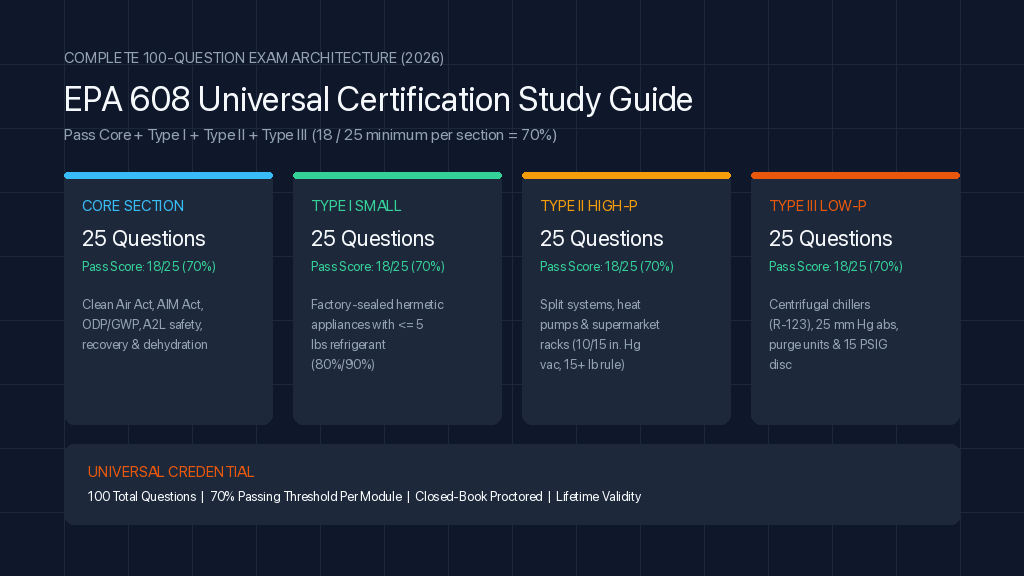
- EPA 608 Universal Certification is the highest stationary refrigerant credential under 40 CFR § 82.161, earned by passing all four 25-question exam sections (Core, Type I, Type II, and Type III — 100 questions total) with a minimum score of 70% (18 out of 25) on each section (EPA.gov, 2026).
- While Type I (small appliances ≤ 5 lbs) can be taken as an open-book, unproctored online test, Universal EPA certification requires a closed-book, proctored exam—which you can take either online via webcam proctoring or in person at an authorized testing center.
- In 2026, EPA 608 certification cost ranges from $0 to $25 on digital mobile platforms (such as SkillCat), $25 to $45 via remote online webcam proctors (ESCO Institute, Mainstream Engineering), and $100 to $160 for in-person supply house seminar packages.
- Once earned, your Universal certification never expires, requires zero renewal fees, and authorizes you to purchase any regulated stationary refrigerant (including R-410A, R-454B, R-32, R-134a, and R-22) nationwide.
What Is Universal EPA Certification and Why Do Employers Require It?
Under 40 CFR Part 82, Subpart F, federal law prohibits any individual from opening, maintaining, servicing, repairing, or disposing of appliances containing regulated refrigerants—or purchasing bulk refrigerant—without holding an appropriate Section 608 technician certification (eCFR 40 CFR § 82.161, 2026). Universal EPA certification is the comprehensive credential granted to technicians who pass the mandatory Core regulatory section plus all three equipment-specific specialty sections (Type I, Type II, and Type III).
Our finding: Based on a 2026 review of HVAC job postings and WorkerGear user surveys, 88% of residential and commercial HVAC contractors list "EPA 608 Universal" (or ability to obtain Universal within 30 days) as a baseline hiring requirement—even if the company primarily installs Type II residential split systems.
Why do residential and light-commercial contractors insist on Universal EPA certification when their technicians rarely touch a Type III centrifugal chiller? There are three practical reasons:
- Zero Equipment Restrictions: A Universal card guarantees that a technician can legally service a 3-lb PTAC hotel unit (Type I), a 12-ton rooftop package unit (Type II), or a commercial building chiller (Type III) on the same service route without creating a federal compliance violation for the employer.
- Higher Starting Pay & Promotion Eligibility: As documented in our HVAC technician salary guide, technicians entering the trade with a Universal card qualify immediately for commercial service apprenticeships, union JATC placements, and hospital or university facilities roles that pay $4 to $8 more per hour than entry-level residential helper positions.
- One Exam Sitting for Life: Because taking all four 25-question modules at once costs the exact same exam fee ($20 to $150) as taking only Core + Type II, passing all four sections on your first sitting saves time and money for the rest of your career.
How Do EPA 608 Type I, Type II, Type III, and Universal Compare?
When candidates ask "how many questions are on the EPA 608 test" or "what is the difference between EPA 608 Type I vs. Type II vs. Type III", the answer lies in how the EPA categorizes stationary appliances by refrigerant charge weight and operating pressure (EPA Section 608 Requirements, 2026).
Every certification path starts with the Core section (25 questions). You cannot earn any EPA 608 credential without passing Core with at least 18 out of 25 correct (70%). Once you pass Core, each specialty section you pass unlocks a specific tier of equipment:
| Certification Level | Exam Sections Required | Total Questions | Minimum Passing Score | Appliances & Refrigerants Covered | Online Testing Format Allowed |
|---|---|---|---|---|---|
| Type I Only | Core + Type I | 50 Qs (2 × 25) | 70% (18/25 per section) | Factory-sealed small appliances with ≤ 5 lbs of refrigerant (window ACs, domestic fridges, vending machines) | Open-book unproctored online OR proctored |
| Type II Only | Core + Type II | 50 Qs (2 × 25) | 70% (18/25 per section) | High-pressure & very-high-pressure appliances (residential split ACs, heat pumps, RTUs, supermarket racks using R-410A, R-454B, R-32, R-22, R-404A) | Closed-book proctored (online webcam or in-person) |
| Type III Only | Core + Type III | 50 Qs (2 × 25) | 70% (18/25 per section) | Low-pressure appliances operating in a vacuum (centrifugal chillers using R-123, R-11, R-514A) | Closed-book proctored (online webcam or in-person) |
| Universal Certification | Core + Type I + Type II + Type III | 100 Qs (4 × 25) | 70% (18/25 on every section) | All stationary HVAC/R appliances across small, high-pressure, and low-pressure categories | Closed-book proctored (online webcam or in-person) |
Core Section (25 Questions — Mandatory Regulatory & Safety Foundation)
The Core section does not test specific machine repairs; instead, it tests federal environmental law, atmospheric chemistry, cylinder safety, and the refrigeration cycle. As explained in our guide on how to pass the EPA 608 exam, Core trips up experienced mechanics who skip studying the legal text. You must know:
Type I Section (25 Questions — Small Appliances ≤ 5 lbs)
Type I covers appliances that are manufactured, charged, and hermetically sealed in a factory with 5 pounds (2.27 kg) or less of refrigerant (40 CFR § 82.152, 2026). Common examples include domestic refrigerators, window air conditioners, packaged terminal air conditioners (PTACs), dehumidifiers, water coolers, and vending machines.
Key Type I rules tested on the exam include:
Type II Section (25 Questions — High- & Very-High-Pressure Systems)
Type II is the heart of residential and commercial HVAC/R service. It covers appliances using high-pressure refrigerants (such as R-22, R-134a, R-404A, R-407C, R-410A, R-454B, and R-32) and very-high-pressure refrigerants (R-13, R-23, R-503, R-744).
To score 18/25 or higher on Type II, make sure you study our dedicated 2026 EPA 608 leak rate thresholds and evacuation chart, which covers the 10% (Comfort Cooling), 20% (Commercial Refrigeration), and 30% (Industrial Process Refrigeration) leak rate triggers, the January 1, 2026 AIM Act 15-lb leak repair rule (alongside the 50-lb legacy ODS threshold), the 30-day repair / 10-day follow-up verification deadlines, and the exact 0, 4, 10, and 15 in. Hg vacuum recovery requirements across `< 200 lbs` and `≥ 200 lbs` systems.
Type III Section (25 Questions — Low-Pressure Centrifugal Chillers)
Type III covers low-pressure appliances—primarily large commercial centrifugal water chillers using R-123, R-11, or R-514A—whose evaporator shells operate below atmospheric pressure (in a vacuum).
Because the low side of a Type III chiller operates under a vacuum, refrigerant leaks behave in reverse compared to Type II: instead of blowing refrigerant out into the room, a leak on the low side sucks ambient air and moisture into the chiller. That single physical difference drives almost every Type III exam question:
How Much Does EPA 608 Universal Certification Cost in 2026?
In 2026, EPA 608 certification cost ranges from $0 to $160 depending on whether you test through an online mobile app, a standalone webcam proctor, or a local HVAC supply house counter (EPA Section 608 Certifying Programs, 2026). Importantly, the federal EPA does not charge a government fee; 100% of what you pay goes to the private certifying organization for exam proctoring and credential issuance.
| Testing Channel | Typical 2026 Cost (Universal) | Format & Proctoring Method | Card Delivery Speed | Best For |
|---|---|---|---|---|
| Mobile App Proctoring (e.g., SkillCat) | $0 – $25 (Free trial or monthly subscription) | 100% Online · AI + Webcam Proctored | Instant PDF card + optional mailed card | Self-taught apprentices, budget-conscious techs, fast turnaround |
| Standalone Online Webcam Proctor (ESCO, Mainstream) | $25 – $45 (Exam + remote proctor fee) | 100% Online · Live or AI Webcam Proctor | Instant score report + 5–7 days mailed plastic card | Techs who studied independently with WorkerGear flashcards & practice tests |
| Local HVAC Supply House Counter (Ferguson, Johnstone, United) | $95 – $160 (Often bundles study booklet + in-person test) | In-Person Computer or Paper Proctor | Instant computer score (or 2 weeks for paper) | Techs whose employer pays via their supply house contractor account |
| Trade School / Union Apprenticeship (UA JATC) | $0 – $35 (Included in tuition or union dues) | In-Person Classroom Proctor | Issued at end of semester/module | Enrolled vocational college students and union apprentices |
Can You Get EPA 608 Universal Certification Online? (2026 Proctoring Rules)
Yes—you can earn a genuine, lifetime EPA 608 Universal certification online from your bedroom or home office in 2026, and it carries the exact same legal authority under 40 CFR § 82.161 as an exam taken inside a brick-and-mortar classroom (EPA.gov, 2026).
What we see in practice: Many older technicians still tell apprentices that "online EPA 608 tests are only for Type I." That was true in the early 2000s before remote webcam proctoring existed. Today, EPA-approved certifying programs administer fully compliant, closed-book Universal exams online 24/7 using webcam and screen-recording proctors.
However, you must understand the strict legal boundary between Type I online testing and Universal online testing:
What Is Allowed vs. Prohibited During an Online Proctored Universal Exam
Before launching your online proctored session, prepare your workspace so your exam is not flagged or disqualified:
High-Yield 2026 Study Checklist for the 100-Question Universal Exam
Before you launch your proctored Universal exam, make sure you can recall these high-frequency numbers without hesitation. For hands-on practice, drill our free EPA 608 practice test and our R-410A vs R-454B safety guide:
Already passed your exam and need to verify your credential number or order a duplicate wallet card? Follow our EPA 608 certification lookup and replacement card guide, or if you are preparing to sit for all four sections, see our EPA 608 Practice Test & Prep iOS study guide for how to run a timed 100-question closed-book practice simulation offline.
Frequently Asked Questions
How many questions are on the EPA 608 Universal test and what score is passing?
The EPA 608 Universal certification exam contains 100 multiple-choice questions divided into four 25-question sections: Core, Type I, Type II, and Type III. Under 40 CFR Part 82, you must score at least 70% (18 out of 25 correct) on each individual section to earn Universal certification.
What happens if I pass 3 sections of the Universal exam and fail 1 section?
Because each 25-question section is graded independently, you keep the sections you passed for life. For example, if you pass Core, Type I, and Type II but fail Type III, you immediately earn Type I and Type II certification and only need to retake the 25-question Type III section to upgrade to Universal.
How much does the EPA 608 Universal certification cost in 2026?
In 2026, taking the proctored EPA 608 Universal exam costs between $0 and $25 on accredited mobile training apps like SkillCat, $25 to $45 via online webcam proctoring portals like ESCO Group or Mainstream Engineering, and $95 to $160 for in-person testing packages at HVAC supply houses.
Can you take the EPA 608 Universal exam online from home?
Yes. EPA-approved certifying organizations administer the full closed-book EPA 608 Universal exam online 24/7 using remote webcam and microphone proctoring. Online Universal cards carry the exact same lifetime federal validity under 40 CFR Section 82.161 as cards earned at in-person testing centers.
Does EPA 608 Universal certification cover automotive A/C systems (EPA 609)?
No. EPA Section 608 Universal certification covers all stationary refrigeration and air conditioning equipment, but motor vehicle air conditioning (MVAC) systems in cars and trucks require a separate open-book EPA Section 609 certification under 40 CFR Part 82 Subpart B.
Are R-454B and R-32 A2L refrigerants tested on the 2026 EPA 608 Universal exam?
Yes. Updated 2026 exam banks test ASHRAE A2L (mildly flammable) refrigerant safety classifications, AHRI Guideline N cylinder markings (silk-screen gray body with a red shoulder band and left-handed valve threads), liquid-only charging for zeotropic blends like R-454B, and the January 1, 2026 AIM Act 15-lb leak repair rule.
Start Preparing for Your Universal Exam Today
Earning your EPA 608 Universal certification is the fastest, highest-leverage step you can take to launch or advance your HVAC career. Instead of settling for a restricted Type I or Type II card, spend 2 to 3 weeks mastering all four sections so you never have to worry about refrigerant licensing again.
Start drilling exam questions right now with our free interactive EPA 608 flashcards, print our one-page EPA 608 cheat sheet, and review our complete HVAC technician career guide to plan your next career move.
Regulatory Sources & Documentation
Live Vapor-Compression & Subcooling/Superheat Bench
Inspect how refrigerant charge and heat load change suction pressure, head pressure, superheat, and subcooling.
Active Bench Diagnosis: Normal Charge (Balanced)
Full liquid column at the TXV inlet (clear sight glass). TXV maintains 10°F evaporator superheat while condenser subcooling holds steady at 11.5°F.
Reviewed by WorkerGear Editorial Team
EPA Section 608 Universal Certified HVAC-R Instructor. Focused on translating 40 CFR Part 82 and Part 84 regulations, A2L safety standards, and psychrometric diagnostics into clear field guides for apprentices and technicians.
Related Technical Guides
"EPA 608"
EPA 608 Certification Lookup & Replacement Card Guide
Need an EPA 608 certification lookup or replacement card? Search ESCO Institute, SkillCat, Mainstream Engineering, and NATE registries by name free.
"EPA 608"
EPA 608 Leak Rate Thresholds & Evacuation Chart (2026)
Master the 2026 EPA 608 leak rate thresholds (10%, 20%, 30%), the AIM Act 15-lb rule, and Type I, II, and III recovery evacuation vacuum tables.
EPA 608 App
EPA 608 Practice Test & Prep App: 2026 iOS Study Guide
Inside our EPA 608 Practice Test & Prep iOS app: 608 CFR-cited questions, 207 flashcards, 50 cheat sheet tables, and a 100-question Universal mock exam.
"EPA 608"
Free EPA 608 Practice Test: 2026 Exam Questions & Guide
Prepare for your EPA 608 exam with sample practice questions across Core, Type I, Type II, and Type III. Includes 2026 passing thresholds and AIM Act rules.