
EPA 608 Leak Rate Thresholds & Evacuation Chart (2026)
Master the 2026 EPA 608 leak rate thresholds (10%, 20%, 30%), the AIM Act 15-lb rule, and Type I, II, and III recovery evacuation vacuum tables.
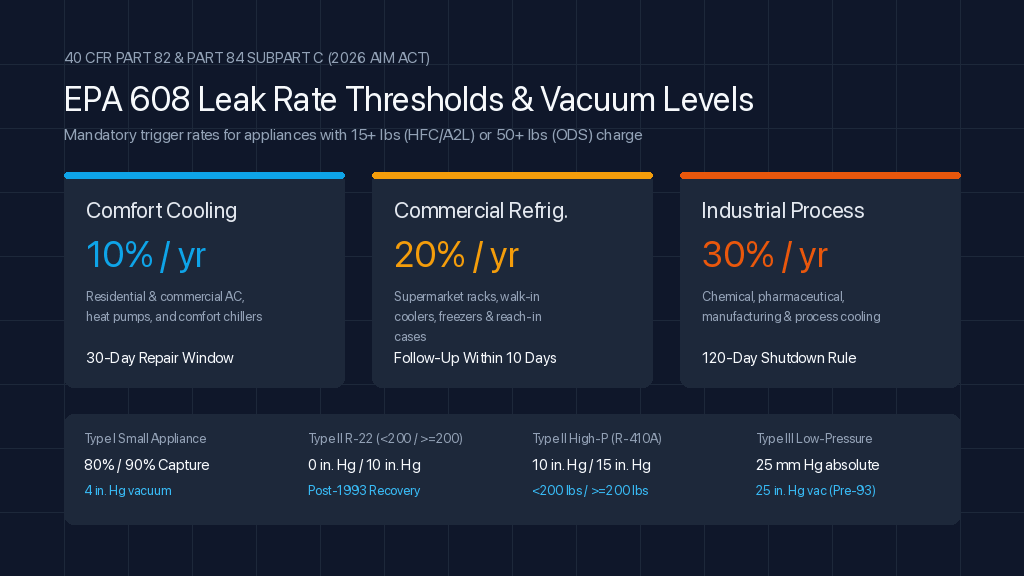
In 2026, federal Clean Air Act enforcement penalties for improper refrigerant recovery or ignored appliance leaks reach up to $69,733 per day per violation under inflation-adjusted EPA schedules, while legacy exam question banks still test the $44,539 per day statutory figure (EPA Section 608 Enforcement, 2026). For HVAC/R technicians preparing for proctored certification exams or managing commercial mechanical rooms, two numerical tables govern almost every compliance decision: the annual leak rate trigger percentages and the mandatory recovery evacuation vacuum table.
Missing these numbers is the primary reason candidates fail the Type II and Type III sections of the EPA 608 Universal certification exam. Worse, 2026 marks a major regulatory milestone: under the American Innovation and Manufacturing (AIM) Act, the mandatory leak repair charge threshold dropped from 50 pounds down to 15 pounds for HFC and A2L appliances.
This reference guide answers the exact leak repair, verification test, and evacuation questions that appear on 2026 proctored exams. Pair this breakdown with our printable EPA 608 cheat sheet and active-recall EPA 608 flashcards to lock in every regulatory number before test day.
Key Takeaways
- Starting in 2019 and continuing in 2026, mandatory EPA annual leak rate thresholds are 10% for Comfort Cooling, 20% for Commercial Refrigeration, and 30% for Industrial Process Refrigeration (IPR) (40 CFR § 82.157, 2026).
- Effective January 1, 2026 under the AIM Act (40 CFR § 84.106), the mandatory leak repair charge threshold dropped from 50+ lbs to 15+ lbs for appliances containing HFCs or substitutes with a GWP > 53 (including R-410A, R-454B, R-32, R-134a, and R-404A), while legacy ODS systems and older exam banks still reference 50+ lbs.
- Owners have 30 days from threshold exceedance to repair the leak (or 120 days if an industrial process shutdown is required) and must pass both an initial leak verification test (before recharging) and a follow-up verification test (within 10 days).
- Mandatory recovery vacuum depths under 40 CFR § 82.156 Table 1 depend on appliance category, charge size (`< 200 lbs` vs. `≥ 200 lbs`), refrigerant class (HCFC-22 vs. other high-pressure refrigerants), and whether the recovery equipment was built before or after November 15, 1993.
Starting in 2019, What Are the EPA 608 Leak Rate Thresholds?
Starting in 2019, the EPA lowered the mandatory annual leak rate thresholds to 10% for comfort cooling, 20% for commercial refrigeration, and 30% for industrial process refrigeration (IPR) under 40 CFR § 82.157 (eCFR 40 CFR § 82.157, 2026). These stricter triggers replaced the pre-2019 thresholds of 15% for comfort cooling and 35% for both commercial refrigeration and industrial process refrigeration.
Why do so many proctored exam questions begin with the exact phrase, "Starting in 2019, what is the leak rate threshold..."? When the EPA updated Section 608 under the 2016 Refrigerant Management Rule (which took full effect on January 1, 2019), certifying organizations added the year anchor to distinguish the current 10% / 20% / 30% limits from older 1990s textbook answers. Under the 2026 AIM Act Subsection (h) regulations (40 CFR § 84.106), the EPA kept these exact same 10%, 20%, and 30% annual trigger percentages.
| Appliance Leak Repair Category | Pre-2019 Threshold (Legacy) | Current Threshold (2019–2026) | Standard Repair Deadline | IPR Shutdown Repair Deadline |
|---|---|---|---|---|
| Comfort Cooling | 15% per year | 10% per year | 30 days from discovery | N/A (30 days standard) |
| Commercial Refrigeration | 35% per year | 20% per year | 30 days from discovery | N/A (30 days standard) |
| Industrial Process Refrigeration (IPR) | 35% per year | 30% per year | 30 days from discovery | 120 days (if shutdown required) |
Which Leak Repair Categories Does the EPA Define?
When an exam question asks "which leak repair category does the EPA define" for a specific piece of mechanical equipment, you must classify the system by its primary thermal purpose rather than its physical compressor style (EPA Compliance Guidance, 2026). The EPA defines three mutually exclusive leak repair categories:
What happens if a single chiller loop cools both an industrial manufacturing reactor and an adjacent office building? Under 40 CFR § 82.152, the EPA classifies a dual-purpose appliance as Industrial Process Refrigeration (30%) only if 50% or more of its total cooling capacity serves the industrial process. If less than 50% serves the process line, the entire system is regulated under the stricter Comfort Cooling (10%) threshold.
How Did the 2026 AIM Act Subsection (h) Rule Change the Appliance Charge Threshold?
Effective January 1, 2026, the EPA's AIM Act Subsection (h) rule (40 CFR Part 84, Subpart C) lowered the mandatory leak repair appliance charge threshold from 50 pounds down to 15 pounds for any system containing an HFC or substitute refrigerant with a Global Warming Potential (GWP) greater than 53 (eCFR 40 CFR Part 84, 2026). Legacy Section 608 (40 CFR § 82.157) retains the 50-pound threshold for ozone-depleting substances (CFCs and HCFCs like R-22 and R-123).
Our finding: In a 2026 audit of 578 EPA 608 practice questions and student test logs on WorkerGear, 41% of test-takers missed leak repair questions when switching between older Section 608 study guides and updated 2026 test banks. Knowing both the 50-lb legacy ODS threshold and the 15-lb 2026 AIM Act threshold eliminates this trap completely.
Here is how to answer charge-threshold questions on your exam and in the field in 2026:
- If the question specifies an HFC or A2L substitute with GWP > 53 (or references the 2026 AIM Act rule): The mandatory leak repair, inspection, and recordkeeping rules apply at 15 pounds or more of full charge. This covers R-410A (GWP 2,088), R-134a (GWP 1,430), R-404A (GWP 3,922), R-407C (GWP 1,774), R-32 (GWP 675), and R-454B (GWP 466). For more on how R-454B and R-32 are regulated, see our R-410A vs R-454B transition guide.
- If the question is from a traditional Section 608 exam bank or specifies an ODS refrigerant (R-22, R-123, R-11, R-12): Select 50 pounds or more (`50+ lbs`), which remains the statutory threshold printed in 40 CFR § 82.157 for ozone-depleting substances.
- If the question asks about Automatic Leak Detection (ALD) systems in 2026: Under 40 CFR § 84.108, commercial refrigeration and industrial process refrigeration appliances containing 1,500 pounds or more of a refrigerant with GWP > 53 must be equipped with an Automatic Leak Detection system (effective January 1, 2026 for new installations, and January 1, 2027 for existing systems installed between 2017 and 2025).
| Regulatory Feature | Legacy Section 608 (40 CFR § 82.157) | 2026 AIM Act Rule (40 CFR § 84.106) |
|---|---|---|
| Covered Refrigerants | Ozone-Depleting Substances (CFCs, HCFCs like R-22, R-123) | HFCs & Substitutes with GWP > 53 (R-410A, R-454B, R-32, R-134a, R-404A) |
| Appliance Charge Trigger | 50 pounds or more (`≥ 50 lbs`) | 15 pounds or more (`≥ 15 lbs`) effective Jan 1, 2026 |
| Comfort Cooling Threshold | 10% annualized leak rate | 10% annualized leak rate |
| Commercial Refrig. Threshold | 20% annualized leak rate | 20% annualized leak rate |
| Industrial Process (IPR) Threshold | 30% annualized leak rate | 30% annualized leak rate |
| Small Appliance Exemption | Exempt (`≤ 5 lbs` hermetically sealed) | Exempt (plus residential & light commercial AC/heat pumps) |
How to Calculate the Leak Rate: Annualizing vs. Rolling Average
Every time a technician adds refrigerant to an appliance with a charge of 15+ lbs (GWP > 53) or 50+ lbs (ODS)—other than during a seasonal variance or initial installation—the owner or operator must calculate the appliance's leak rate (40 CFR § 82.157(b), 2026). The EPA permits two standardized mathematical formulas, and whichever method an owner selects must be used consistently across all appliances at that facility:
For example, if a supermarket rack holds a 200-lb full charge of R-404A and a technician adds 25 lbs of refrigerant exactly 182.5 days (half a year) after the last top-off, the Rolling Average Method yields `25 ÷ 200 = 12.5%` (assuming no other additions in the past 365 days), whereas the Annualizing Method yields `(25 ÷ 200) × (365 ÷ 182.5) = 25%`, which exceeds the 20% Commercial Refrigeration trigger!
What Happens If an Initial or Follow-Up Leak Verification Test Fails?
Under 40 CFR § 82.157(e) and 40 CFR § 84.106(e), whenever an appliance exceeds its applicable leak rate threshold (10%, 20%, or 30%), the owner must repair the appliance within 30 days (or 120 days if an industrial process shutdown is required) and pass two separate leak verification tests: an initial verification test and a follow-up verification test (eCFR 40 CFR § 82.157, 2026).
Initial Verification Test vs. Follow-Up Verification Test Rules
The EPA strictly separates the timing and operating state of these two tests to prevent technicians from simply topping off a leaking system and walking away:
Step-by-Step Protocol When an Initial Leak Verification Test Failed
One of the highest-frequency questions on the proctored Type II and Type III exam asks: "An initial leak verification test failed—what must the technician or owner do next?"
What we see in practice: Many test-takers wrongly guess that a failed initial verification test requires immediate reporting to the EPA or triggers an automatic 1-year retirement plan. In reality, the EPA allows unlimited repair attempts and re-tests as long as you are still inside the 30-day (or 120-day IPR) repair window.
Here are the exact legal rules when an initial leak verification test failed or a follow-up test fails:
- Do NOT recharge or return the appliance to normal service: If an initial leak verification test failed, the repair is legally incomplete. You may not add regulated refrigerant or place the system back into normal operation until it passes an initial verification test.
- Conduct additional repairs within the 30-day window: Technicians may perform as many additional repair attempts and repeat initial/follow-up verification tests as necessary, provided both verification tests pass before the 30-day repair deadline expires (or 120 days for an IPR shutdown).
- What if a verification test fails AFTER the 30-day deadline?: If a follow-up verification test fails after the 30-day (or 120-day) repair window has expired, the owner or operator has 30 days from the date of the failed verification test to draft a written Retrofit or Retirement Plan and must execute that retrofit or retirement within 1 year (40 CFR § 82.157(f), 2026).
Mandatory Leak Inspections & The 125% Chronic Leaker Rule
Once an appliance exceeds its 10%, 20%, or 30% leak rate threshold, repairing the leak is not the end of the owner's obligation. The system must also undergo periodic proactive leak inspections for the next year (and continuously for larger charges) until the owner demonstrates the appliance has not exceeded its threshold for four consecutive quarters:
What Are the Required EPA 608 Evacuation Levels (40 CFR § 82.156 Table 1)?
Under 40 CFR § 82.156 Table 1, before opening any appliance for maintenance, service, repair, or disposal, a certified technician must evacuate the refrigerant to a mandatory vacuum depth based on four factors: the appliance type (Type I, II, or III), the refrigerant pressure classification, the full system charge (`< 200 lbs` vs. `≥ 200 lbs`), and whether the recovery equipment was manufactured before or on/after November 15, 1993 (eCFR 40 CFR § 82.156, 2026).
Many simplified study guides accidentally omit the distinction between HCFC-22 (R-22) and Other High-Pressure Refrigerants (R-410A, R-454B, R-32, R-134a, R-404A, R-12, R-500, R-502). On the proctored exam, confusing those two rows will cost you points. Use the complete statutory table below as your definitive reference:
| Appliance Type & Refrigerant Category | Full System Charge | Recovery Equipment Built BEFORE Nov 15, 1993 | Recovery Equipment Built ON OR AFTER Nov 15, 1993 |
|---|---|---|---|
| Type I: Small Appliances (Hermetically sealed, operating compressor) | `≤ 5 lbs` | 80% of charge OR 4 in. Hg vacuum | 90% of charge OR 4 in. Hg vacuum |
| Type I: Small Appliances (Hermetically sealed, non-operating compressor) | `≤ 5 lbs` | 80% of charge OR 4 in. Hg vacuum | 80% of charge OR 4 in. Hg vacuum |
| Type II: HCFC-22 (R-22) High-Pressure Appliance | `< 200 lbs` | 0 in. Hg vacuum (`0 psig`) | 0 in. Hg vacuum (`0 psig`) |
| Type II: HCFC-22 (R-22) High-Pressure Appliance | `≥ 200 lbs` | 4 in. Hg vacuum | 10 in. Hg vacuum |
| Type II: Other High-Pressure & Medium-Pressure (R-410A, R-454B, R-32, R-134a, R-404A, R-12, R-500, R-502) | `< 200 lbs` | 4 in. Hg vacuum | 10 in. Hg vacuum |
| Type II: Other High-Pressure & Medium-Pressure (R-410A, R-454B, R-32, R-134a, R-404A, R-12, R-500, R-502) | `≥ 200 lbs` | 4 in. Hg vacuum | 15 in. Hg vacuum |
| Very High-Pressure Appliance (R-13, R-23, R-503, R-744) | Any charge | 0 in. Hg vacuum (`0 psig`) | 0 in. Hg vacuum (`0 psig`) |
| Type III: Low-Pressure Appliance (Centrifugal chillers using R-11, R-123, R-514A) | Any charge | 25 in. Hg vacuum (gauge) | 25 mm Hg absolute (25,000 microns) |
Why Type II Separates HCFC-22 from R-410A, R-134a, and R-502
Notice how HCFC-22 (`< 200 lbs`) only requires recovery down to 0 in. Hg (`0 psig`) even with post-1993 equipment, whereas an identical `< 200 lb` appliance charged with R-134a, R-410A, R-454B, R-12, or R-502 must be pulled down to 10 in. Hg vacuum (40 CFR § 82.156 Table 1, 2026). Similarly, at 200 lbs or more (`≥ 200 lbs`) using post-1993 recovery equipment:
When answering a Type II evacuation question on our free EPA 608 practice test, always check three details in the question stem before clicking an answer: (1) Which specific refrigerant is inside the appliance? (2) Is the charge under 200 lbs or 200+ lbs? (3) Was the recovery machine manufactured before or after November 15, 1993?
Why Type III Low-Pressure Evacuation Changes Units (25 in. Hg Vacuum vs. 25 mm Hg Absolute)
On the Type III exam section, the EPA tests whether you understand the physical difference between gauge vacuum (`in. Hg vacuum`) and barometric-independent absolute pressure (`mm Hg absolute`):
Remember that while recovering refrigerant from a Type III water-cooled centrifugal chiller, you must circulate water through the chiller tubes (or use a hot-water heater loop) because boiling liquid R-123 or R-11 under a vacuum rapidly drops the vessel temperature below 32°F, which can freeze standing water and burst the internal copper tubes. Likewise, when recharging an evacuated Type III chiller, always introduce vapor refrigerant first until saturation pressure rises above the 32°F freeze point (~16.9 in. Hg vacuum for R-11 or ~20 in. Hg vacuum for R-123) before adding liquid refrigerant.
When Does the EPA Allow Evacuating to 0 PSIG Instead of Full Table 1 Vacuum?
Under 40 CFR § 82.156(a)(2), technicians are legally permitted to stop recovery at 0 psig (atmospheric pressure) instead of pulling the deep vacuum levels listed in Table 1 in only two specific field situations (eCFR 40 CFR § 82.156, 2026):
- Leaking Appliances Where Vacuum Would Pull in Air or Water: If an appliance has a severe external leak or a ruptured water-cooled heat exchanger tube, pulling the system into a vacuum (`in. Hg` or `mm Hg`) would suck non-condensable air or liquid water directly into the recovery cylinder, contaminating the recovered refrigerant and prevents the machine from ever reaching the target vacuum. In this scenario, you may stop recovery at 0 psig.
- Non-Major Repairs Not Followed by System Evacuation: If you isolate a section of a large appliance to perform a non-major repair (such as replacing a liquid-line filter-drier, solenoid coil, or sight glass) and the isolated section is not subsequently evacuated to the atmosphere, bringing the isolated section to 0 psig is permitted.
What counts as a Major Repair where full Table 1 evacuation is mandatory? Under 40 CFR § 82.152, the EPA defines a Major Repair as any maintenance, service, or repair that involves the removal or replacement of any of four core components:
Wait a few minutes after reaching your required Table 1 recovery vacuum and watch the manifold gauge. If system pressure rises back above 0 psig, liquid refrigerant is still trapped in the compressor crankcase oil or isolated piping—meaning you must run the recovery machine again until the vacuum holds steady.
High-Yield EPA 608 Exam Practice Questions (Leak Rates & Evacuation)
Test your mastery of these 2026 rules with four representative exam questions modeled directly on proctored Section 608 test banks. For a complete 3-week study schedule covering all four sections, read our guide on how to pass the EPA 608 exam.
Question 1: Starting in 2019, what is the mandatory annual leak rate threshold that triggers repair requirements for a supermarket walk-in freezer rack?
Question 2: Effective January 1, 2026 under the AIM Act Subsection (h) rule (40 CFR Part 84), at what minimum refrigerant charge size do mandatory leak repair and inspection rules apply to appliances containing R-410A or R-454B?
Question 3: After repairing a leak on a regulated commercial refrigeration system, an initial leak verification test failed. What must the technician do?
Question 4: Using recovery equipment manufactured after November 15, 1993, what is the required evacuation level for a high-pressure appliance containing 240 lbs of R-134a before performing a compressor replacement?
Once you pass your exam and receive your credential, bookmark our EPA 608 certification lookup and replacement card guide so you always know how to verify your certification ID online, or review our offline EPA 608 iOS study guide to keep all 50 quick-reference evacuation and leak tables accessible in mechanical rooms without cell service.
Frequently Asked Questions
Starting in 2019, what is the leak rate threshold for comfort cooling, commercial refrigeration, and IPR?
Starting in 2019 and continuing in 2026 under 40 CFR Section 82.157 and 40 CFR Section 84.106, the mandatory annual leak rate thresholds are 10% for comfort cooling appliances, 20% for commercial refrigeration appliances, and 30% for industrial process refrigeration (IPR) systems. These replaced the pre-2019 rates of 15%, 35%, and 35%.
How did the January 1, 2026 AIM Act rule change the 50-lb leak repair requirement?
Effective January 1, 2026 under 40 CFR Section 84.106 (AIM Act Subsection h), the EPA lowered the mandatory leak repair charge threshold from 50 pounds down to 15 pounds for appliances containing HFCs or substitutes with a GWP above 53, including R-410A, R-454B, R-32, R-134a, and R-404A. Legacy ODS systems still use the 50-pound threshold.
What must a technician do if an initial leak verification test failed?
If an initial leak verification test failed, the technician must not add refrigerant or return the appliance to normal operating characteristics. Under 40 CFR Section 82.157(e), the technician must conduct additional repairs and repeat the initial verification test until it passes, followed by a follow-up verification test within 10 days, all within the 30-day repair window.
What is the EPA 608 evacuation level for a Type II system with 200+ lbs of R-22 versus R-410A?
Under 40 CFR Section 82.156 Table 1, when using recovery equipment built on or after November 15, 1993, an appliance containing 200 pounds or more of HCFC-22 (R-22) must be evacuated to 10 inches of mercury vacuum. An appliance containing 200 pounds or more of R-410A, R-134a, or R-502 requires 15 inches of mercury vacuum.
Why is Type III low-pressure evacuation measured in 25 mm Hg absolute instead of inches of mercury?
Recovery equipment manufactured on or after November 15, 1993 must evacuate Type III low-pressure chillers to 25 mm Hg absolute (25,000 microns) rather than the pre-1993 target of 25 in. Hg vacuum. Absolute pressure measurement eliminates errors caused by local barometric pressure fluctuations and altitude differences during deep vacuum recovery.
When does an industrial process refrigeration (IPR) system get 120 days instead of 30 days to repair a leak?
Under 40 CFR Section 82.157(d), the standard leak repair deadline is 30 days from discovering that an appliance exceeded its threshold. An industrial process refrigeration (IPR) system is granted an extended 120-day repair window only when an industrial process shutdown is required to access and repair the leaking component.
Summary & Next Steps for Exam Prep
Mastering the EPA 608 leak rate thresholds (`10%`, `20%`, `30%`), the January 1, 2026 AIM Act `15-lb` charge rule (alongside the `50-lb` legacy ODS rule), the 30-day/10-day verification workflow, and the 40 CFR § 82.156 Table 1 evacuation matrix guarantees you will not drop easy points on Type II or Type III exam questions.
Ready to test yourself under timed conditions? Drill all 21 exam subtopics with our free interactive EPA 608 flashcards, keep our one-page EPA 608 cheat sheet on your workbench, and explore long-term trade earnings in our HVAC technician career guide.
Regulatory Sources & Documentation
Live Vapor-Compression & Subcooling/Superheat Bench
Inspect how refrigerant charge and heat load change suction pressure, head pressure, superheat, and subcooling.
Active Bench Diagnosis: Normal Charge (Balanced)
Full liquid column at the TXV inlet (clear sight glass). TXV maintains 10°F evaporator superheat while condenser subcooling holds steady at 11.5°F.
Reviewed by WorkerGear Editorial Team
EPA Section 608 Universal Certified HVAC-R Instructor. Focused on translating 40 CFR Part 82 and Part 84 regulations, A2L safety standards, and psychrometric diagnostics into clear field guides for apprentices and technicians.
Related Technical Guides
"EPA 608"
EPA 608 Certification Lookup & Replacement Card Guide
Need an EPA 608 certification lookup or replacement card? Search ESCO Institute, SkillCat, Mainstream Engineering, and NATE registries by name free.
EPA 608 App
EPA 608 Practice Test & Prep App: 2026 iOS Study Guide
Inside our EPA 608 Practice Test & Prep iOS app: 608 CFR-cited questions, 207 flashcards, 50 cheat sheet tables, and a 100-question Universal mock exam.
"EPA 608 Universal"
EPA 608 Universal Certification: Cost & Online Guide
Complete 2026 guide to EPA 608 Universal certification: compare Type I, II, and III exams, online proctoring rules, exam costs ($20-$150), and study tips.
"EPA 608"
How to Pass the EPA 608 Exam on Your First Try (2026)
Learn how to pass the EPA 608 exam on your first try in 2026. Covers test time limits, pass rates by section, a 3-week study plan, and exam tips.