
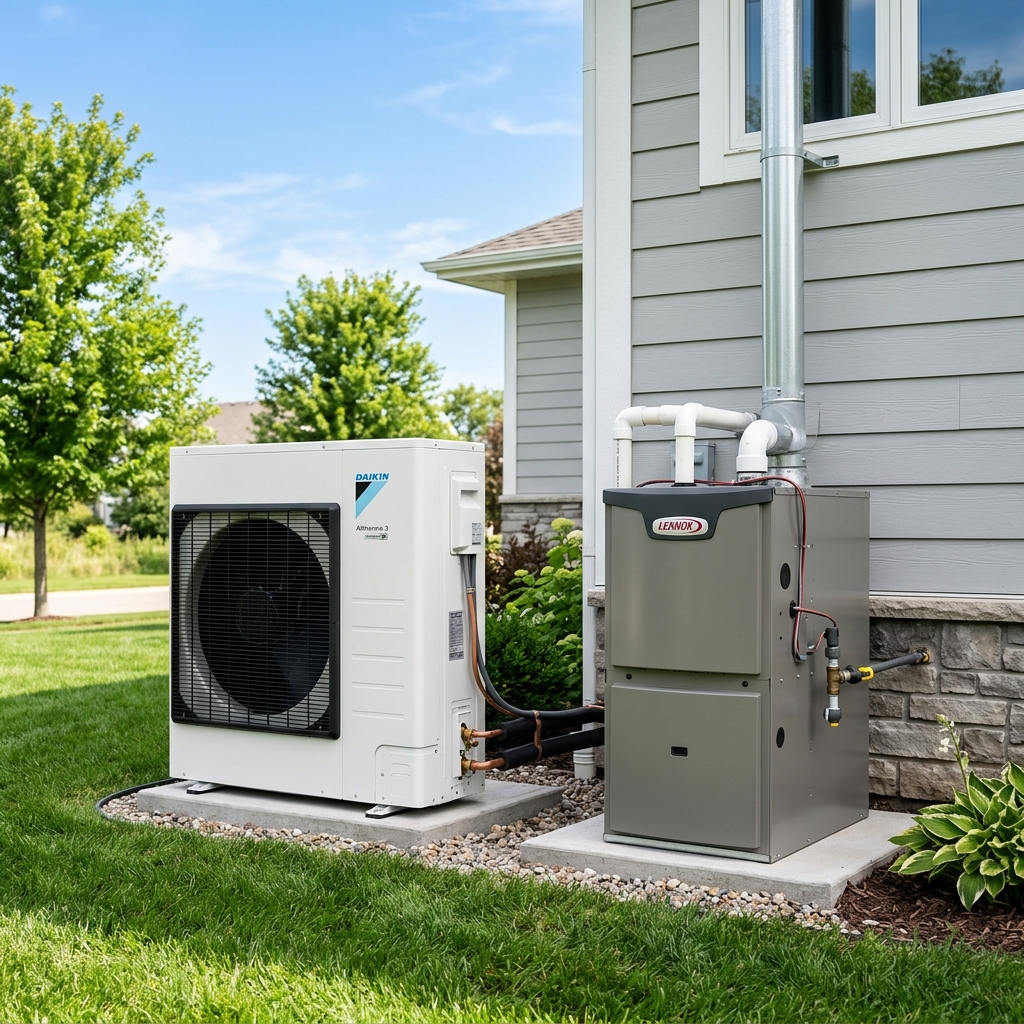
Heat Pump vs Furnace: Which Is Right?
Heat pumps cost $4,500 to $10,000 installed and handle heating and cooling. Furnaces run $2,500 to $7,500. Compare efficiency, costs, and climate fit.
About 60% of US homes still rely on a furnace as their primary heating source, according to the US Energy Information Administration (2020 RECS). But heat pump installations have been growing by double digits every year since the Inflation Reduction Act passed in 2022. If you're replacing your heating system in 2026, you'll probably get quotes for both.
The decision comes down to your climate, your fuel costs, and what you want the system to do. A furnace heats your home. A heat pump heats and cools it. That difference matters more than most people realize when they're comparing bottom-line prices.
This guide breaks down how each system works, what they cost, how they perform in different climates, and when a dual-fuel setup makes more sense than picking one or the other.
- Heat pumps handle both heating and cooling. Furnaces only heat.
- A heat pump costs $4,500 to $10,000 installed. A gas furnace costs $2,500 to $7,500.
- Heat pumps are more efficient in moderate climates (above 25°F). Furnaces are better for extreme cold.
- The Inflation Reduction Act provides up to $2,000 in tax credits for qualifying heat pump installations through 2032.
- A dual-fuel system (heat pump + gas furnace backup) is the best option for cold-climate homeowners.
How Does a Heat Pump Work?
A heat pump moves heat instead of generating it. In cooling mode, it pulls heat from indoor air and dumps it outside, exactly like an air conditioner. In heating mode, it reverses the process and pulls heat from outdoor air into your home.
Yes, outdoor air contains extractable heat even at low temperatures. A modern cold-climate heat pump can pull heat from air as cold as -15°F. The compressor concentrates that heat and pushes it inside through refrigerant lines. Learn more about this process in our guide to how HVAC systems work.
The efficiency metric for heat pump heating is HSPF2 (Heating Seasonal Performance Factor 2). A typical heat pump has an HSPF2 of 8 to 10, meaning it produces 8 to 10 BTUs of heat for every watt of electricity consumed. That is 200 to 300% efficient. No combustion system can match that ratio.
The catch: as temperatures drop below 25 to 30°F, a standard heat pump's efficiency drops. It has to work harder to extract heat from colder air. That's where the furnace vs. heat pump debate gets interesting.
How Does a Gas Furnace Work?
A gas furnace burns natural gas (or propane) to generate heat. The burner ignites gas inside a heat exchanger. Air blows across the heat exchanger, picks up that heat, and the blower pushes it through ductwork into your rooms. Combustion gases vent outside through a flue pipe.
Furnace efficiency is measured by AFUE (Annual Fuel Utilization Efficiency). A standard-efficiency furnace has an 80% AFUE, meaning 20% of the fuel's energy goes up the flue. A high-efficiency condensing furnace hits 95 to 98% AFUE because it recaptures heat from exhaust gases that would otherwise escape.
One thing a furnace does well: it produces very hot air. Supply air from a gas furnace comes out at 120 to 140°F. A heat pump typically delivers air at 90 to 100°F. Both will heat your home to the same temperature, but the furnace feels warmer at the register. Some homeowners notice this difference and prefer it.
Cost Comparison: Heat Pump vs Furnace
The upfront cost depends on the equipment, your home's existing infrastructure, and your region.
| Factor | Heat Pump | Gas Furnace |
|---|---|---|
| Equipment cost | $2,500 to $5,500 | $1,500 to $3,500 |
| Installation labor | $2,000 to $4,500 | $1,000 to $4,000 |
| Total installed cost | $4,500 to $10,000 | $2,500 to $7,500 |
| Handles cooling? | Yes | No (need separate AC) |
| SEER2 range | 14 to 23 | N/A |
| HSPF2 / AFUE | 8 to 10 HSPF2 | 80% to 98% AFUE |
| Average lifespan | 15 to 20 years | 20 to 30 years |
| Federal tax credit | Up to $2,000 (IRA) | None for gas |
The IRA tax credit of up to $2,000 for qualifying heat pump installations makes the math even more favorable. Check DSIRE for state and utility rebates that stack on top.
Operating Cost: Which Is Cheaper to Run?
This depends almost entirely on your local electricity and gas rates.
In areas where electricity costs $0.12 to $0.15 per kWh and natural gas costs $1.00 to $1.20 per therm, a heat pump and a 95% AFUE furnace will cost about the same to run per heating season. But if electricity is above $0.20 per kWh and gas is cheap, the furnace wins on monthly bills. If gas is expensive (above $1.50 per therm) or unavailable, the heat pump wins clearly.
The US average electricity rate in 2025 was $0.167 per kWh, and the average natural gas rate was $1.03 per therm (EIA, 2025). At those averages, a heat pump costs roughly the same as a high-efficiency gas furnace to operate in moderate climates.
In cooling season, the comparison is irrelevant. The furnace doesn't cool at all. You'll need a separate AC unit, which adds to both equipment and operating costs.
Climate Performance: When Each System Wins
This is where the decision gets simple.
Heat pump wins in these climates:
Gas furnace wins in these climates:
Dual-fuel wins in these climates:
A dual-fuel system pairs a heat pump with a gas furnace. The heat pump handles heating when outdoor temperatures are above the balance point (usually 30 to 35°F). When temperatures drop below that point, the system switches to the gas furnace automatically. You get the efficiency of a heat pump most of the time and the raw heating power of a furnace when you actually need it.
The Refrigerant Factor: R-454B and New Equipment
Starting January 2025, new residential heat pumps and air conditioners manufactured in the US must use low-GWP refrigerants like R-454B under the AIM Act. R-454B has a global warming potential of 466, which is 78% lower than R-410A's GWP of 2,088 (EPA, 2025).
This affects heat pumps directly because they use refrigerant for both heating and cooling. Furnaces don't use refrigerant at all, so this regulation has no impact on a standalone furnace installation. If you're interested in the full breakdown of the refrigerant transition, read our R-410A vs R-454B comparison.
For buyers, the practical impact is small. R-454B equipment performs the same as R-410A equipment. The main difference is that R-454B is classified as A2L (mildly flammable), which means your installer needs to follow updated safety codes. You won't notice a difference in daily operation.
What About Ductless Options?
If your home doesn't have ductwork, a ductless mini-split heat pump is worth considering. Mini-splits skip the ducts entirely. An outdoor compressor connects to indoor wall-mounted units, each controlling its own zone.
Mini-splits are popular in older homes, room additions, and finished basements where running ductwork is impractical or too expensive. They also tend to have higher SEER2 ratings (up to 30+) than traditional ducted systems.
The downside: if you have 5 or more rooms to condition, a ducted system is usually cheaper to install than running individual mini-split heads to each room.
Frequently Asked Questions
Is a heat pump better than a furnace?
It depends on your climate and energy costs. In moderate climates where temperatures stay above 25°F most of the winter, a heat pump is usually the better choice because it handles both heating and cooling with one system and uses less energy. In very cold climates, a gas furnace or a dual-fuel setup (heat pump plus furnace) is more practical.
Can a heat pump replace a furnace?
Yes. A heat pump can fully replace a furnace in mild to moderate climates. In cold climates, a cold-climate heat pump rated for operation down to -15°F can work as the sole heating source, but many homeowners prefer a dual-fuel backup for the coldest days. Your HVAC contractor should run a Manual J load calculation to confirm the heat pump can handle your home's heating load.
How long does a heat pump last compared to a furnace?
A heat pump typically lasts 15 to 20 years. A gas furnace lasts 20 to 30 years. Heat pumps have a shorter lifespan partly because they run year-round (heating in winter, cooling in summer), which puts more wear on the compressor. Regular HVAC maintenance extends the life of either system.
Do heat pumps work in cold weather?
Modern cold-climate heat pumps can operate efficiently down to about -15°F. Brands like Mitsubishi (Hyper-Heat) and Bosch (Climate 5000) are designed for cold climates. Below their rated temperature, efficiency drops and the system may need supplemental heat. That's why dual-fuel systems exist: the gas furnace kicks in only during the coldest periods.
Are heat pumps loud?
Heat pumps are generally quieter than they used to be. Modern variable-speed heat pumps operate at 55 to 65 dB outdoors, about the same as a normal conversation. Indoor units are even quieter at 25 to 40 dB. Furnaces produce noise mainly from the blower motor and can reach 50 to 60 dB indoors.
Summary
The heat pump vs. furnace decision comes down to three things: your climate, your fuel costs, and whether you also need air conditioning.
Get three quotes from licensed contractors before deciding. Make sure each quote includes a Manual J load calculation, not just a guess based on your square footage.
About WorkerGear Team
HVAC Instructor and Certified EPA Technician. Dedicated to helping students and HVAC apprentices pass their trade certification exams on the first attempt with expert tips and exam insights.