
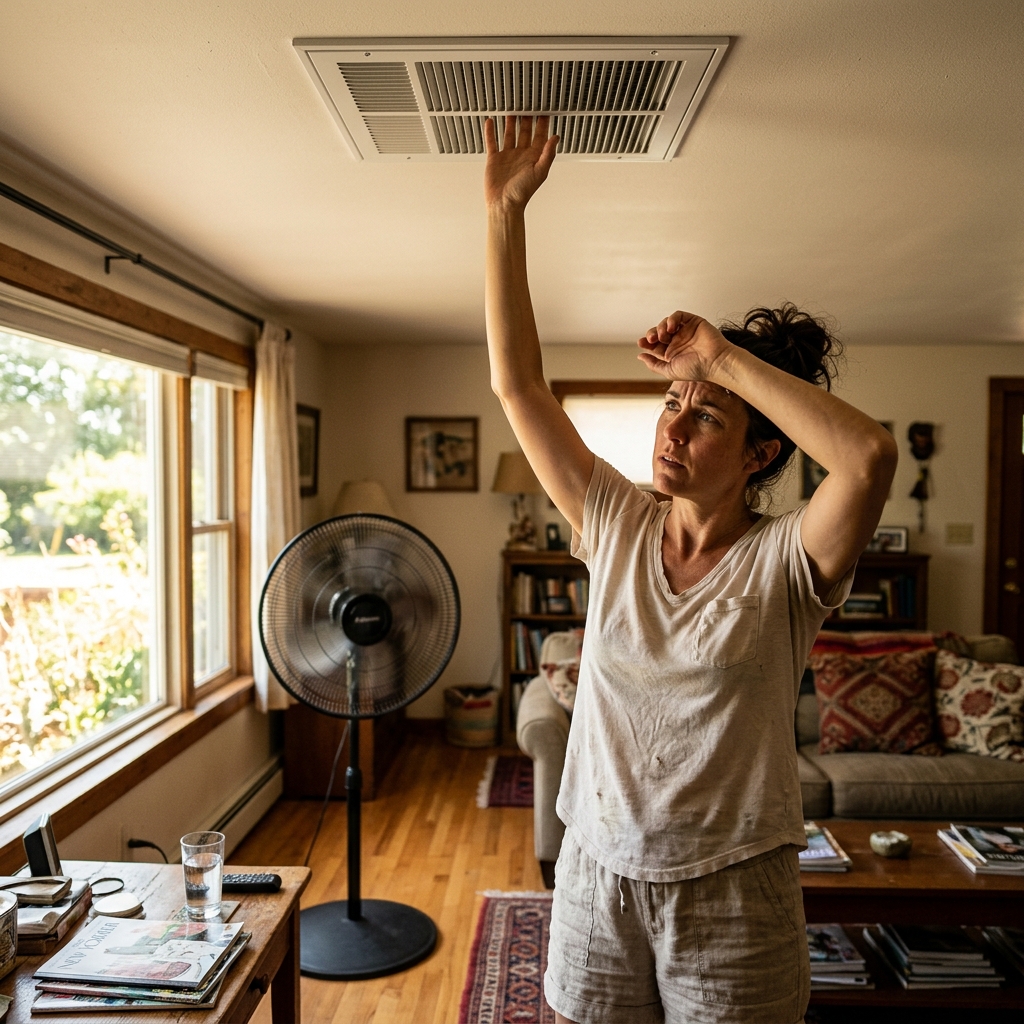
HVAC Not Cooling? 8 Things to Check First
AC running but not cooling? Troubleshoot 8 common causes from dirty filters to refrigerant leaks, and learn when to call a certified technician.
Your AC is running but the house isn't getting cooler. Before you call a technician and pay a $75 to $150 diagnostic fee, there are several things you can check yourself. According to HVAC service companies, about 40% of "AC not cooling" service calls turn out to be simple problems that homeowners could have fixed on their own (ACHR News, 2024).
This list starts with the easiest, cheapest fixes and works down to problems that actually need a professional. Try them in order.
- About 40% of AC service calls are caused by simple, fixable issues: dirty filters, thermostat settings, or tripped breakers.
- A dirty air filter is the single most common cause of poor cooling performance.
- Check your thermostat, filter, circuit breaker, and outdoor unit before calling a technician.
- Ice on the refrigerant line or outdoor unit means shut the system off and call for service.
- Regular maintenance prevents most cooling failures.
1. Check the Thermostat Settings
This sounds obvious, but it's the first thing HVAC technicians check because it solves the problem surprisingly often.
Verify that your thermostat is set to "Cool" mode (not "Heat" or "Off"). Check that the temperature setpoint is below the current room temperature. If the setpoint is 75°F and the room is 74°F, the system won't run.
Also check the fan setting. It should be on "Auto," not "On." When set to "On," the blower runs continuously even when the compressor isn't running, which blows unconditioned air and makes it feel like the AC isn't working.
If you have a programmable or smart thermostat, check whether a schedule or energy-saving mode changed the setpoint. Power outages can also reset thermostat settings to defaults.
Try this: Set the thermostat to "Cool," drop the setpoint 5 degrees below the current room temperature, and set the fan to "Auto." Wait 5 minutes. If the outdoor unit starts up and cold air comes from the vents, the thermostat was the problem.
2. Check the Air Filter
A clogged air filter is the number one cause of reduced cooling performance. When the filter is dirty, it restricts airflow across the evaporator coil. The coil gets too cold, moisture freezes on it, and eventually the coil ices over completely. A frozen evaporator coil can't absorb heat. Your system blows air, but it's not cold.
Pull the filter out and hold it up to a light. If you can't see light through it, replace it immediately. In summer, a standard 1-inch filter can clog in as little as 2 to 3 weeks if you have pets or leave windows open.
After replacing the filter, if the coil was frozen, set the system to "Fan Only" (no cooling) for 1 to 2 hours to let the ice melt. Then switch back to cooling mode. If it starts cooling normally, the filter was your problem.
For a full filter schedule and other maintenance tasks, see our HVAC maintenance checklist.
3. Check the Circuit Breaker
Your HVAC system typically has two circuit breakers: one for the indoor unit (furnace or air handler) and one for the outdoor unit (condenser). If the indoor breaker is on but the outdoor breaker has tripped, the blower runs and pushes air through the ducts, but the compressor isn't running and the air isn't cold.
Check your electrical panel. If a breaker is in the "tripped" position (usually in the middle, between on and off), flip it fully off, wait 30 seconds, and flip it back on. If it trips again immediately, don't keep resetting it. There's an electrical problem that needs a technician.
Also check the disconnect switch near the outdoor unit. This is a small box mounted on the wall near the condenser. Some have a pull-out handle that acts as a switch. Make sure it's in the "on" position. Landscapers and painters sometimes bump these off accidentally.
4. Look at the Outdoor Unit
Go outside and look at the condenser unit. Is it running? You should hear the fan and compressor operating. If it's completely silent, the problem might be the breaker, the contactor, or a failed compressor.
If it is running, check for obvious problems:
Debris. Leaves, grass clippings, cottonwood seeds, and dirt accumulate on the condenser coils and block airflow. If the coils are visibly dirty, turn off the unit and gently spray them with a garden hose from the inside out. Let it dry before restarting.
Clearance. Make sure nothing is within 2 feet of the unit on all sides. Bushes, fences, and stored items restrict airflow.
Fan operation. The fan on top should be spinning. If the compressor is humming but the fan isn't spinning, the fan motor or capacitor may have failed. This needs a technician.
5. Check All Supply and Return Vents
Walk through your house and check every supply vent (where cold air comes out) and return vent (where air gets pulled back). Make sure all of them are open and unobstructed.
Common problems:
If several vents are closed or blocked, the system can't circulate enough air. Open them all and give the system 30 minutes to catch up.
6. Inspect the Refrigerant Lines
Two copper lines run from the outdoor unit through the wall to the indoor unit. The larger one (the suction line) should be insulated with foam and feel cold to the touch during cooling. The smaller one (the liquid line) should feel warm.
Check for ice. If you see frost or ice on either line, especially the suction line, your system has a problem. The most common causes are low refrigerant (a leak) or severely restricted airflow (dirty filter or frozen coil). Turn off the system and let the ice melt completely before running it again. If icing recurs after changing the filter and letting the system defrost, you need a technician to check the refrigerant charge.
Check for damaged insulation. If the insulation on the suction line is torn or missing, the line absorbs heat from the ambient air, which reduces cooling efficiency. Replace damaged insulation with foam pipe wrap from a hardware store.
7. Check the Condensate Drain
Your AC removes moisture from the air as it cools. That water drains through a condensate line, usually a PVC pipe that exits near the outdoor unit or into a floor drain. If this line clogs (algae, mold, and dust are common culprits), the water backs up.
Many systems have a safety float switch that shuts off the cooling system if the drain backs up, to prevent water damage. If your AC suddenly stops cooling with no other obvious cause, a clogged condensate drain might be triggering the safety switch.
To clear a minor clog, try pouring a cup of distilled white vinegar down the drain line access point (usually a T-fitting or cap near the indoor unit). For a stubborn clog, use a wet/dry vacuum on the outdoor end of the drain line.
8. Consider the System's Age and Capacity
If none of the above fixes the problem, the issue might be more fundamental.
Age. An AC system older than 15 years loses cooling capacity as the compressor wears out. If your 18-year-old system can't keep up on a 95°F day but worked fine on an 85°F day, the compressor is probably on its last legs. At that age, replacement makes more financial sense than repair. Check out our HVAC cost guide to understand pricing.
Undersized system. If the system was never big enough for your home (or you've added square footage since installation), it will run constantly without reaching the setpoint on hot days. A Manual J load calculation from a licensed contractor can confirm whether your system is properly sized.
Extreme heat. Most residential AC systems are designed to maintain a 20°F temperature difference between indoor and outdoor temperatures. On a 110°F day, an AC set to 75°F is being asked for a 35°F differential. It will run nonstop and may not reach the setpoint. That's not a malfunction. It's a design limitation.
When to Call a Technician
If you've gone through all 8 checks and the system still isn't cooling, the problem likely involves:
Tell the technician what you've already checked. It saves diagnostic time and might reduce the service call cost.
Frequently Asked Questions
Why is my AC running but not cooling the house?
The most common causes are a dirty air filter, a tripped outdoor breaker, a refrigerant leak, or a dirty condenser coil. Start with the filter. If it's clean and the system still isn't cooling, work through the 8 checks in this guide. If none of them fix it, the problem is likely refrigerant or compressor related and needs a professional.
How do I know if my AC is low on refrigerant?
Signs of low refrigerant include: ice on the refrigerant lines or outdoor unit, warm air from the supply vents even though the system is running, a hissing or bubbling sound near the outdoor unit, and the system running continuously without reaching the setpoint. A technician can measure the refrigerant charge with gauges.
Is it bad to run the AC when it's not cooling?
Running the system with a frozen coil or extremely low refrigerant can damage the compressor, which is the most expensive component to replace. If your system is icing up or you suspect a refrigerant leak, turn it off and call a technician. Running it continuously with a dirty filter is wasteful but won't cause immediate damage. Just change the filter.
Should I replace or repair my AC if it stops cooling?
Use the 50% rule: if the repair costs more than 50% of a new system, replace it. If your system is older than 15 years, lean toward replacement regardless. If it's under 10 years old and the repair is a single component (capacitor, fan motor, contactor), repair it. See our HVAC cost guide for replacement pricing.
How long should it take for AC to cool a house?
On a typical summer day, your AC should cool the house to the thermostat setpoint within 2 to 3 hours of turning on. If it runs for 4+ hours and doesn't reach the setpoint, something is wrong. Check the filter first, then work through this guide.
Summary
Before spending money on a service call, check these 8 things in order:
1. Thermostat settings (mode, setpoint, fan setting) 2. Air filter (replace if dirty) 3. Circuit breaker (for both indoor and outdoor units) 4. Outdoor unit (running, clean, clear of debris) 5. Supply and return vents (open and unblocked) 6. Refrigerant lines (no ice, insulation intact) 7. Condensate drain (not clogged) 8. System age and capacity (realistic expectations)
About 40% of the time, one of these checks will solve the problem. The other 60% requires a licensed technician. Either way, you'll know more about what's wrong before the technician arrives, which helps you make better decisions about repair vs. replacement.
The best way to avoid cooling failures? Stick to a regular maintenance schedule. A $5 filter and a $100 tune-up cost a lot less than a $150 emergency service call on the hottest day of the year.
About WorkerGear Team
HVAC Instructor and Certified EPA Technician. Dedicated to helping students and HVAC apprentices pass their trade certification exams on the first attempt with expert tips and exam insights.