
HVAC Certification Types: 2026 EPA 608, 609 & NATE Guide
Compare mandatory and voluntary HVAC certifications in 2026. Learn requirements for EPA 608, EPA 609, NATE CHP-5, A2L safety, and state licenses.
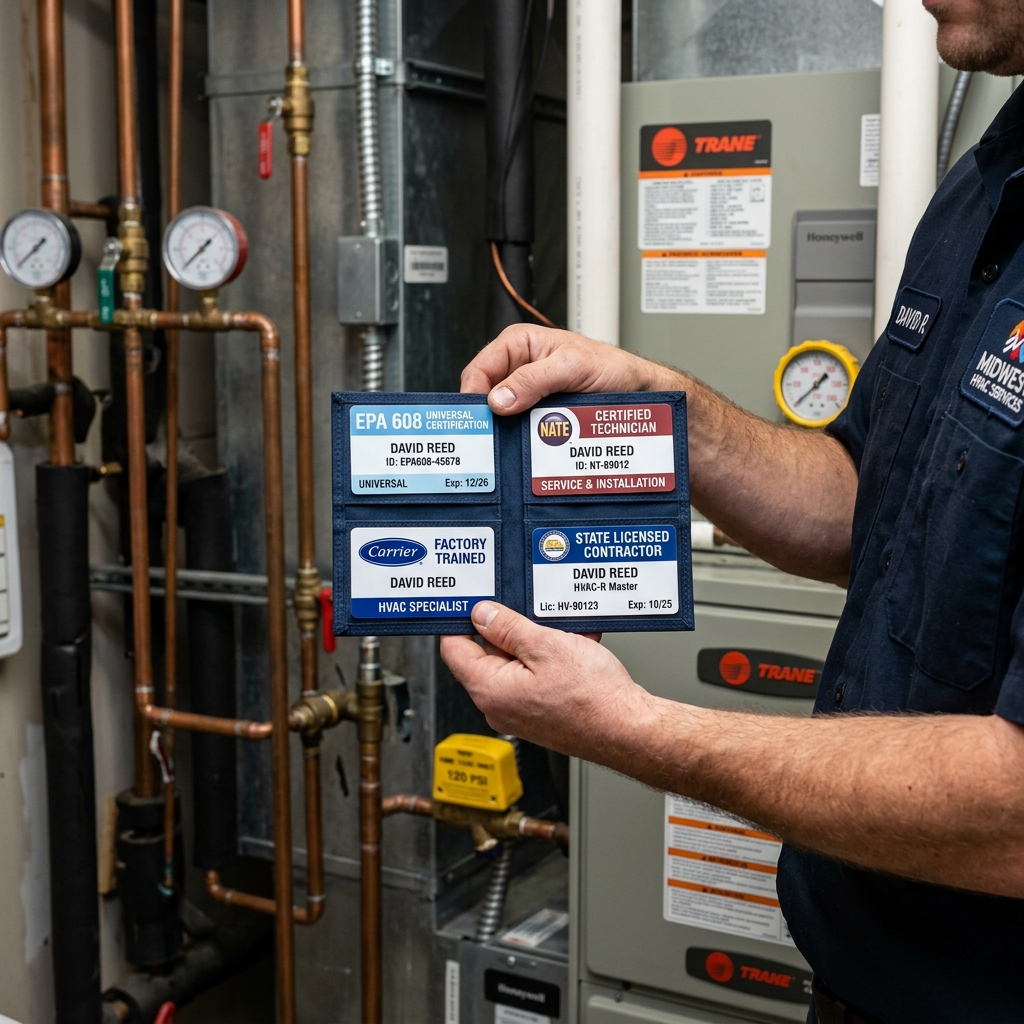
In 2026, navigating the maze of mandatory federal certifications, voluntary industry credentials, and state contractor licenses is essential for every HVAC technician (EPA.gov, 2026). While EPA Section 608 certification is mandatory under federal law for handling stationary refrigerants, additional credentials—such as NATE's CHP-5 (Certified HVAC Professional) pathway, A2L mildly flammable refrigerant safety certificates, and EPA Section 609—open lucrative career paths in commercial HVAC/R and automotive A/C service.
This comprehensive guide breaks down every major HVAC certification in 2026, detailing test formats, costs, expiration rules, and hourly wage premiums.
Key Takeaways
- EPA Section 608 certification is mandatory nationwide under 40 CFR Part 82 Subpart F for servicing stationary HVAC/R systems (EPA.gov, 2026).
- EPA Section 609 certification is required specifically for servicing motor vehicle air conditioning (MVAC) systems.
- NATE (North American Technician Excellence) offers both the 5-exam CHP-5 (Certified HVAC Professional) pathway and traditional Core + Specialty exams, boosting technician pay by $3.00 to $6.00 per hour.
- With R-454B and R-32 now standard in 2026 equipment, employers increasingly expect A2L Refrigerant Safety Certification.
- Prepare for mandatory exams using WorkerGear's EPA 608 practice test and 190+ Free EPA 608 Flashcards.
Which HVAC Certifications Are Mandatory vs. Voluntary in 2026?
In 2026, certifications fall into two categories: Mandatory Regulatory Licenses and Voluntary Skill Credentials (BLS.gov, 2026). To see how credentials fit into overall career growth, read our flagship HVAC technician career guide.
Detailed Comparison Table
| Certification | Authority | Scope | Typical Cost | Expiration |
|---|---|---|---|---|
| EPA 608 Core/Universal | Federal EPA | Stationary HVAC/R Systems | $20 – $150 | Never (Lifetime) |
| EPA 609 MVAC | Federal EPA | Motor Vehicle A/C Systems | $20 – $40 | Never (Lifetime) |
| NATE (CHP-5 / Specialty) | Industry Non-Profit | Advanced Technical Mastery | $150 – $300 | 2 Years (16 CEHs) |
| HVAC Excellence | Industry Board | Employment Ready & Mastery Modules | $50 – $100 | Never (Lifetime) |
| A2L Safety Certification | ESCO / NATE / OEMs | R-454B & R-32 Flammable Handling | $25 – $75 | Never (Lifetime) |
| State Journeyman License | State Licensing Board | Regional Mechanical / Contracting | $100 – $300 | 1–2 Years |
1. Why Is EPA Section 608 Certification Mandatory for Stationary HVAC?
In 2026, Section 608 of the Clean Air Act (40 CFR Part 82) and the AIM Act (40 CFR Part 84) require certification for anyone opening, maintaining, servicing, or disposing of stationary equipment containing regulated refrigerants (EPA.gov, 2026). Every HVAC student and apprentice in 2026 must earn this credential before handling refrigerants in the field.
According to WorkerGear study testing data, Universal Certification (passing Core, Type I, Type II, and Type III—100 multiple-choice questions total, requiring 70% or 18/25 on each section) is held by 88% of employed technicians because employers prefer versatile technicians who can service any system size.
Prepare using our complete EPA 608 Universal certification study guide, test yourself with our EPA 608 practice test, and review study strategies in how to pass the EPA 608 exam. If you already passed your test and need to verify your number or order a replacement card, read our EPA 608 certification lookup and replacement card guide.
2. When Do You Need EPA Section 609 Automotive MVAC Certification?
In 2026, technicians servicing motor vehicle air conditioning (MVAC) systems in passenger cars, trucks, buses, or farm/construction equipment must hold EPA Section 609 certification (EPA.gov, 2026).
Many technicians confuse EPA 608 and EPA 609. EPA 608 does not cover automotive R-134a, R-1234yf, or R-744 ($\text{CO}_2$) cab systems, and EPA 609 does not cover residential split systems or commercial walk-in coolers. If you work on transport refrigeration units (reefer trucks), you need both credentials (EPA 609 for the truck cab A/C and EPA 608 Type II for the refrigerated cargo box).
Read our full guide on EPA 609 certification rules.
3. How Does NATE Certification (CHP-5) Increase Technician Pay?
In 2026, North American Technician Excellence (NATE) remains the premier voluntary certification recognized nationwide by contractors and equipment manufacturers (NATE, 2026). NATE now offers a structured three-tier career ladder alongside traditional specialty testing:
- NATE Ready-to-Work & HVAC Support Technician: Entry-level exams designed for apprentices in their first 0 to 12 months on the job.
- NATE CHP-5 (Certified HVAC Professional) Pathway: Instead of sitting for one marathon exam, the modern CHP-5 pathway breaks NATE certification into five progressive 30-question domain exams:
- Traditional NATE Core + Specialty Exams: Experienced technicians (1–2+ years in the field) can also pass the NATE Core exam plus a Specialty exam (such as Air Conditioning, Air-to-Air Heat Pumps, Gas Heating, Commercial Refrigeration, or Hydronics).
NATE-certified technicians earn $3.00 to $6.00 more per hour ($6,000 to $12,500+ more per year) than non-certified peers. Explore full pay tiers in our HVAC technician salary guide.
4. Why Do Technicians Need A2L Flammable Refrigerant Training in 2026?
With the EPA AIM Act transition to R-454B and R-32 in full effect across 2026 residential and light commercial equipment, every technician working on modern split systems should hold an A2L Refrigerant Safety Certificate (offered by HVAC Excellence/ESCO Institute, NATE, and major OEMs). These modules cover UL 60335-2-40 room charge limits, active indoor Refrigerant Detection System (RDS) mitigation boards, left-handed CGA 164 cylinder threads, and spark-free recovery tools. See our detailed technical breakdown of R-410A vs R-454B.
When preparing for your mandatory EPA 608 Universal exam or reviewing A2L cylinder rules before heading into the shop, you can study with our 190+ Free EPA 608 Flashcards, our printable EPA 608 cheat sheet, or our offline EPA 608 Practice Test & Prep iOS app guide (featuring 608 CFR-cited practice questions, 207 flashcards, and a 100-question Universal mock exam).
Frequently Asked Questions
Which HVAC certification should I get first?
EPA Section 608 Universal Certification is mandatory by federal law and should be your first priority before applying for HVAC jobs (EPA.gov, 2026).Does EPA 608 certification expire?
No. EPA Section 608 certification is valid for life (`Never (Lifetime)`) once earned. If you lose your wallet card, follow our EPA 608 certification lookup and replacement card guide.What is the NATE CHP-5 certification pathway?
The NATE CHP-5 (Certified HVAC Professional) pathway divides full NATE certification into five 30-question exams (HVAC Fundamentals, Electrical & Controls, Comfort & Airflow, Installation, and Service) that students and apprentices can pass progressively as they learn each subject.Can I take the EPA 608 exam online?
Yes. Type I exams can be taken open-book online, while EPA 608 Universal exams can be taken online with a live remote webcam proctor or in person at an accredited testing center.Where can I practice for my EPA 608 certification?
WorkerGear provides 190+ Free EPA 608 Flashcards on our interactive flashcards page, a printable EPA 608 cheat sheet, and our EPA 608 Universal certification study guide.Summary & Source References
Holding the right certifications validates your technical expertise and unlocks higher pay tiers throughout your trade career. Start with EPA 608 Universal, add an A2L safety credential, and pursue NATE CHP-5 or specialty certification as you build field experience.
Prepare for your certification exams today with WorkerGear's 190+ Free EPA 608 Flashcards and our EPA 608 cheat sheet.
Source Documentation
Reviewed by WorkerGear Team
EPA Section 608 Universal Certified HVAC-R Instructor. Focused on translating 40 CFR Part 82 and Part 84 regulations, A2L safety standards, and psychrometric diagnostics into clear field guides for apprentices and technicians.
Related Technical Guides
"EPA 608"
EPA 608 Certification Lookup & Replacement Card Guide
Need an EPA 608 certification lookup or replacement card? Search ESCO Institute, SkillCat, Mainstream Engineering, and NATE registries by name free.
"EPA 608"
EPA 608 Leak Rate Thresholds & Evacuation Chart (2026)
Master the 2026 EPA 608 leak rate thresholds (10%, 20%, 30%), the AIM Act 15-lb rule, and Type I, II, and III recovery evacuation vacuum tables.
"EPA 608"
How to Pass the EPA 608 Exam on Your First Try (2026)
Learn how to pass the EPA 608 exam on your first try in 2026. Covers test time limits, pass rates by section, a 3-week study plan, and exam tips.
"EPA 608"
Free EPA 608 Practice Test: 2026 Exam Questions & Guide
Prepare for your EPA 608 exam with sample practice questions across Core, Type I, Type II, and Type III. Includes 2026 passing thresholds and AIM Act rules.